How to compare fencing quotations properly
Compare the full fencing specification, removal work, exclusions, VAT and written terms before deciding which installed price offers the right value.
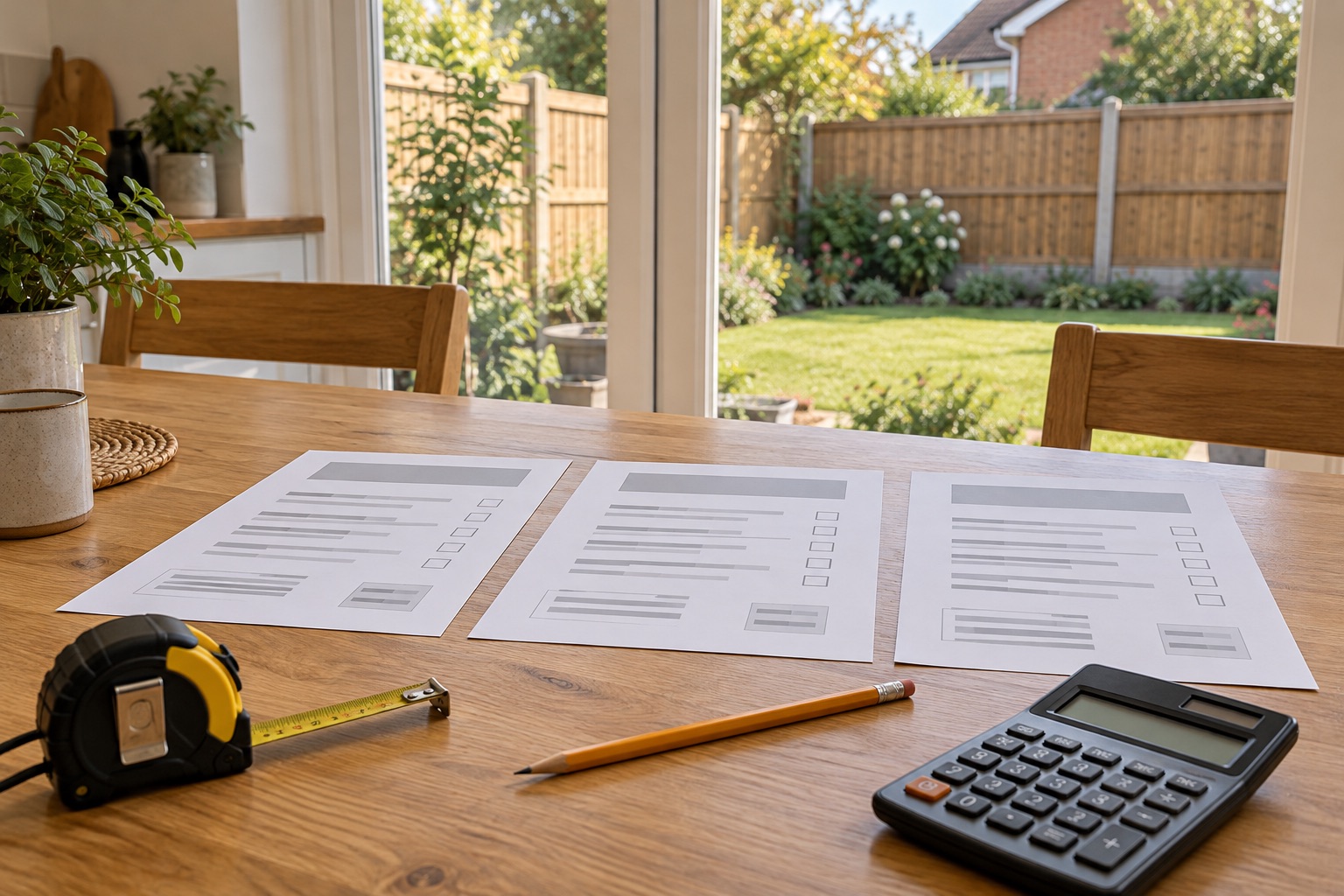
Planning a project? Use our printable measuring and quotation-comparison pack to record your brief and compare written offers.
Use the same brief, check the complete installed specification and identify exclusions or provisional work. A higher price may include more work; a lower one may offer a different product. Neither conclusion can be drawn from the headline figure alone.
Make sure everyone is pricing the same job
One installer has allowed for new posts and removal of the old concrete. Another plans to reuse the posts. A third has priced a different fence height. All three figures might be reasonable for the work described, yet their totals tell you very little about who offers the best value for your intended project.
Prepare a shared brief before asking for prices. Include the approximate runs, finished height, preferred style, post options, gates, removal and access. Mark anything you want advice on rather than filling the gap with a guess. Our measuring guide helps you gather the useful starting details.
If one installer recommends a different approach, ask for the reason and a separately described alternative. A better idea is worth considering. The problem is not a difference between recommendations; it is a difference that remains hidden inside the price.
Is the figure a quotation, an estimate or a budget illustration?
Ask the business to identify the status of its price and the work it covers. Citizens Advice distinguishes a quotation for agreed work from an estimate of likely cost. Keep the written scope, assumptions and any agreed changes with the price. See its England guidance on arranging home improvements.
Our own fence-cost estimator is a third thing: an editorial budgeting tool. It has not surveyed your garden, reserved materials or offered a contract. A difference between that illustration and an actual quote is a reason to examine the specification, not evidence that the installer has priced incorrectly.
Be particularly clear about figures supplied before a visit. Ask which assumptions remain unverified and what would happen if inspection changes them. Do not turn “approximately” into an expectation of a fixed complete job without discussing it.
Read the specification line by line
| Item | What should be clear? |
|---|---|
| Extent | Which runs, lengths, gates and retained sections are covered |
| Finished height | Whether bases, gravel boards and toppers are included in the described height |
| Fence construction | Actual panel or component system, rather than “standard fencing” |
| Posts and foundations | Material, compatible fittings and the proposed approach to site conditions |
| Removal | Old panels, posts, concrete and any separately agreed clearance |
| Completion | Waste, making good, access protection and the agreed finish |
| Commercial terms | VAT, validity, payment stages, changes and any written warranty |
You do not need every screw priced separately. You do need enough information to recognise a meaningful substitution. If the chosen product is described by a manufacturer and model, keep that reference. If it is site-built, ask for the component specification and proposed layout to be described.
A phrase such as “heavy duty” does not replace those details. The closeboard comparison and post-material guide explain the questions behind common product descriptions.
Check the work below and around the visible fence
Removal can be a significant difference between quotes. “Take down existing fence” might need clarification: does it include posts, their foundations and taking the waste away? What happens where old concrete makes the proposed layout more difficult? Ask before comparing a fully allowed job with a price that excludes those items.
For materials taken away, establish the agreed disposal arrangements. GOV.UK explains the distinction between household waste collections and waste produced by a tradesperson's work, along with checks on authorised waste handling. Read the official waste-disposal guidance instead of accepting an unexplained promise to “get rid of it”.
Look around the boundary too. Protection for a paved access route, removal of agreed obstructions and making good a disturbed area should not be left to competing assumptions. Mark items that are outside the fencing work, such as separately commissioned tree work, so they do not disappear between contractors.
A worked comparison without invented market prices
Imagine three quotations for the same rear-garden boundary. These are hypothetical scopes, not quotations from Bedford businesses.
- Option A: new panels fitted between existing posts, with the old panels removed.
- Option B: new panels and posts, including foundation work and agreed disposal.
- Option C: a closeboard fence built on site, with a different finished appearance and a separate gate item.
Putting their totals in ascending order would not settle the choice. First decide whether retaining the posts in A is appropriate, whether B includes all the required work, and whether the design in C is something you actually want. Then request any changes needed to make the alternatives useful.
If the supports are uncertain, ask for an assessment and the limitations of the repair option. If the only difference is appearance, decide what that preference is worth to you. Keep structural needs separate from upgrades chosen because you like them.
Our repair-versus-replacement guide helps with that distinction. The cheapest proposal can be poor value if it leaves the original problem unresolved; the most expensive can also be unnecessary for the outcome you need.
Agree how unknown work will be handled
Ask what could change after work begins and what has already been allowed for. A clear answer identifies the uncertainty, how the installer would explain the finding and how you would authorise a proposed change. “We will discuss it if necessary” is worth turning into a written process.
Keep changes in one place: the revised scope, the price effect and your agreement before additional work proceeds. Citizens Advice's guidance on home-improvement problems explains why the distinction between quotes, estimates and agreed changes matters if a bill is disputed.
This does not mean every unexpected site condition has a predetermined answer. It means you understand the business's proposal and do not have to reconstruct an important conversation after the boundary has been dismantled.
Look beyond the total to the working relationship
Confirm who you are engaging, their contact details and who will carry out the installation. Ask about relevant insurance and verify credentials that influence your decision through the organisation concerned. A logo on a quotation should not be the end of a check.
Discuss payment stages, start arrangements, expected duration and how weather or access problems would be communicated. Read the written cancellation and change terms before accepting work. Where rights or contractual wording are unclear, obtain independent consumer advice rather than assume every agreement has identical rules.
Separate product warranties from promises about workmanship. Establish who provides each promise, what it covers and whether associated labour is included. A long headline period is not a complete explanation of what happens if something goes wrong.
Keep Bedford-specific checks in the scope
Make sure the person pricing the job knows about access through the house, parking or unloading constraints, retained planting and any property restrictions already identified. Those details belong in the common brief, not only in a conversation with the first installer to visit.
Use the Bedford planning guide and ownership guide to identify unresolved questions. Agree who is checking permissions and what must be settled before work begins. A price for installation does not itself confirm authority to change a boundary.
This site is an independent guide and enquiry service, not the contractor issuing the quotation. Compare any eventual partner quote on the same basis you would use for another business. There is no need to accept a price simply because an enquiry began here.
Resolve the gaps before making the final comparison
If totals differ, use the price-differences guide to work out whether the cause is specification, retained parts, access or a different price basis. Send a short list of the unresolved items and keep each business's reply with its proposal.
The removal guide helps clarify foundations and waste. The installer guide covers evidence and identity checks; the payment and paperwork guide covers the terms to understand before accepting.
Record any revised scope rather than replacing a total on your comparison sheet and forgetting why it changed. You should be able to explain the chosen proposal without relying on assumptions carried over from an earlier conversation.
Before saying yes
- Can you describe the agreed fence and the exact work in plain language?
- Are inclusions, exclusions and unresolved assumptions visible?
- Is the total clear, including the stated VAT treatment?
- Do payment, change and timing arrangements make sense to you?
- Have you retained the specification and written terms?
- Do you understand the answer if a cheaper option has been ruled out?
If you cannot answer one of those questions, ask for clarification before accepting. A useful quotation is not simply a price you can afford. It is a clear account of the work you have chosen to buy.
Check that the proposal reflects the survey findings, including foundation assumptions and the complete programme.