Fence post foundations: what should your installation include?
Understand the questions behind post foundations, ground assumptions, concrete products and retained bases without relying on a universal hole depth or bag count.
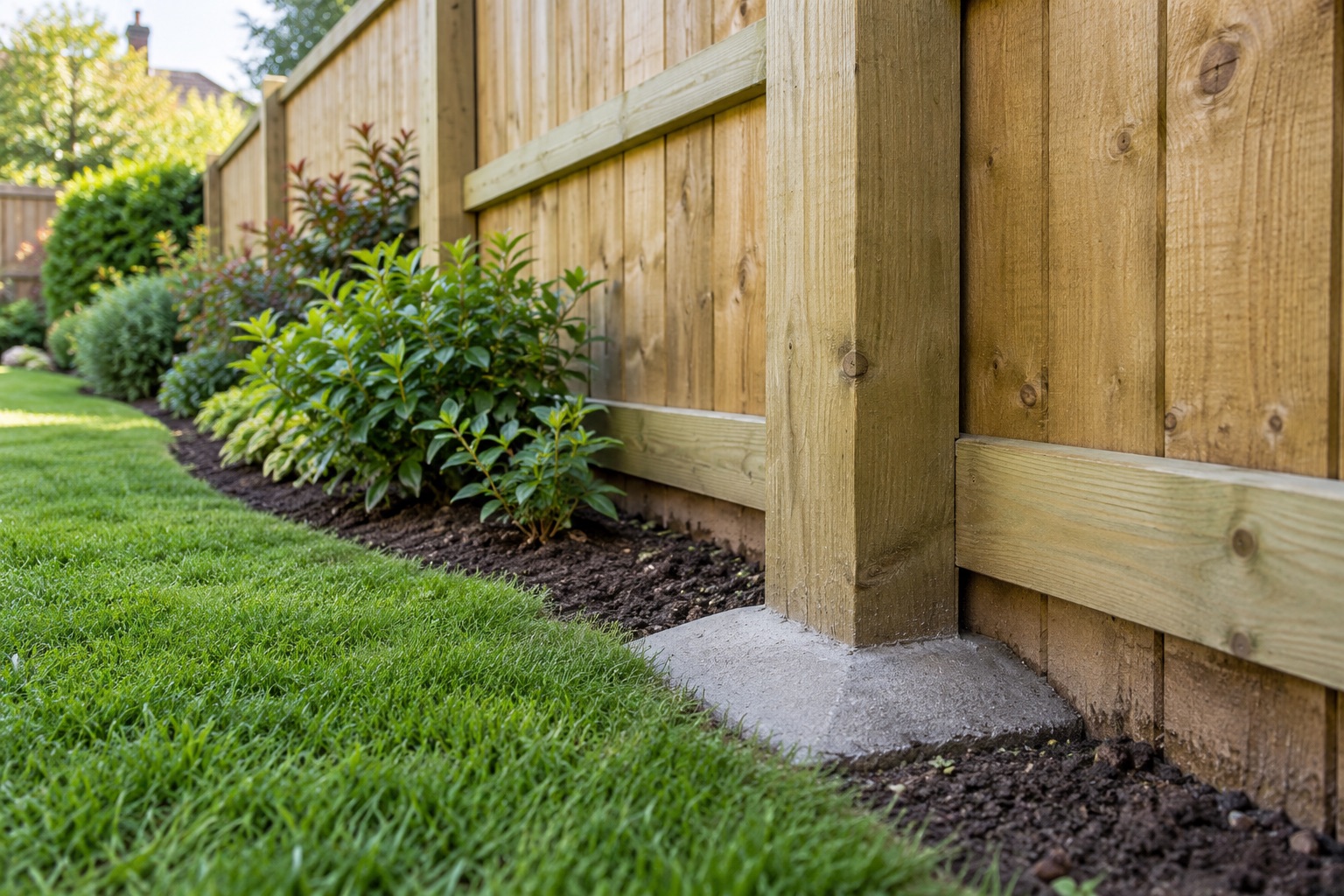
Post size, height, loading, exposure, ground conditions and nearby constraints all matter. Ask the installer to explain the specification; do not treat one depth, hole diameter or bag count as correct for every garden.
What is the foundation doing?
The foundation and surrounding ground support the post, which in turn supports the fence. Panels, rails, gates and connections form part of that system. Choosing a decorative panel first and treating its supports as an afterthought can leave the most important part of the proposal unclear.
A taller or more solid boundary can present different demands from a low open fence. A gate also introduces its own loads and operating requirements. Ask how the supports have been selected for the proposed assembly rather than assuming the same detail suits every post along it.
This guide explains what to discuss and record. It is not an excavation or structural design method. Where the site or proposed work is complex, the installer may need specialist input before confirming a suitable solution.
Why there is no universal depth here
You will see familiar rules of thumb in installation articles. They may be useful starting points within a specified system, but they do not establish an adequate foundation for every soil, height, slope or exposure.
For example, Jacksons publishes installation information for its slotted timber posts. That information concerns those products and their application. Read it with the full instructions, and do not transplant a single dimension into an unrelated fence.
Ask what ground assumptions the quote makes and what happens if excavation reveals something different. Made ground, old foundations, roots and services may affect the proposed positions or method. A deeper hole is not automatically the answer to every obstruction.
What should the survey establish?
Identify the fence line, finished levels, visible structures and known constraints. Tell the installer about earlier groundwork, persistent wet areas or buried material you know about. Describe observations rather than diagnosing the soil from the postcode.
There is no single ground specification for Bedford gardens. Even a nearby project may not represent your plot. Ask which details have been observed and which will only be confirmed during work.
Where the fence meets a retaining structure, building, drain or raised garden, clarify the relationship. Do not assume the ordinary fence foundation is designed to retain soil or stabilise an adjacent wall. Those functions may require separate assessment.
Concrete, post-setting mixes and other systems
“Concrete included” is an incomplete specification. Ask what product or mix is intended, how its instructions will be followed and what protection or waiting period is required. A rapid-setting product and conventional concrete are not interchangeable simply because both support a post.
Blue Circle's Postcrete information gives a particular product's characteristics. Its initial-set description should not be used as a universal loading time or as instructions for another brand. The actual bag instructions and technical guidance matter.
Other post systems may use designed ground anchors, shoes or base plates. Their suitability depends on the product, substrate and loading. Fixing into a thin paving slab or an unverified old base should not be assumed equivalent to a designed foundation.
Timber specification and ground-level detail
Ask for timber suited to its intended use. The Wood Protection Association's Use Class 4 guidance is relevant to ground contact and exterior structural support. Colour alone does not establish the treatment specification or condition of a post.
Discuss cut ends, connections and the finished ground detail with the supplier's instructions in hand. Do not assume brushing a cut surface converts an unsuitable timber component into one specified for ground contact. Our timber treatment guide explains that distinction.
Ask how the finished surface around the post will be left, including any intended water-shedding detail. The aim is a complete suitable assembly, not simply an attractive visible concrete collar above an unknown foundation.
Checks before excavation
Buried services need an appropriate investigation and working plan. HSE's HSG47 guidance explains the framework. An existing hole or an old fence line is not proof that nearby ground is clear. Our services guide helps prepare the homeowner information.
Trees need a separate check too. Do not instruct root cutting to keep a convenient post spacing. Refer to trees and fencing where the proposed positions may affect roots.
Cement products also require appropriate handling. HSE's cement guidance describes skin and dust risks. These materials are not harmless garden fillers; leave their use to a suitable method and the relevant product precautions.
Can old concrete stay?
Sometimes retained foundations or supports can form part of a suitable proposal, but they need assessment. The visible top does not show the full size, condition or relationship to a replacement post. Ask what is being retained and why.
Our reuse guide covers the difference between retaining a sound post, reusing an assembly and finding an old concrete block where a new post is meant to go. Those are different decisions with different costs.
What to confirm in writing
- The selected posts and compatible fence system.
- The foundation approach and relevant product instructions.
- Ground assumptions and the response to hidden obstructions.
- Removal or retention of existing concrete.
- Any separate retaining, drainage or specialist work.
- Weather limitations, protection and handover instructions.
A clear scope allows meaningful quotation comparison. The cheapest bag allowance is not a useful measure of the quality of a foundation; understanding what is specified for the site is.