Timber treatment explained: pressure treatment, dipping and use classes
Understand what treated timber means for fencing, which questions to ask about use class, cut ends, maintenance and written product specifications.
In this guideShow sectionsHide sections
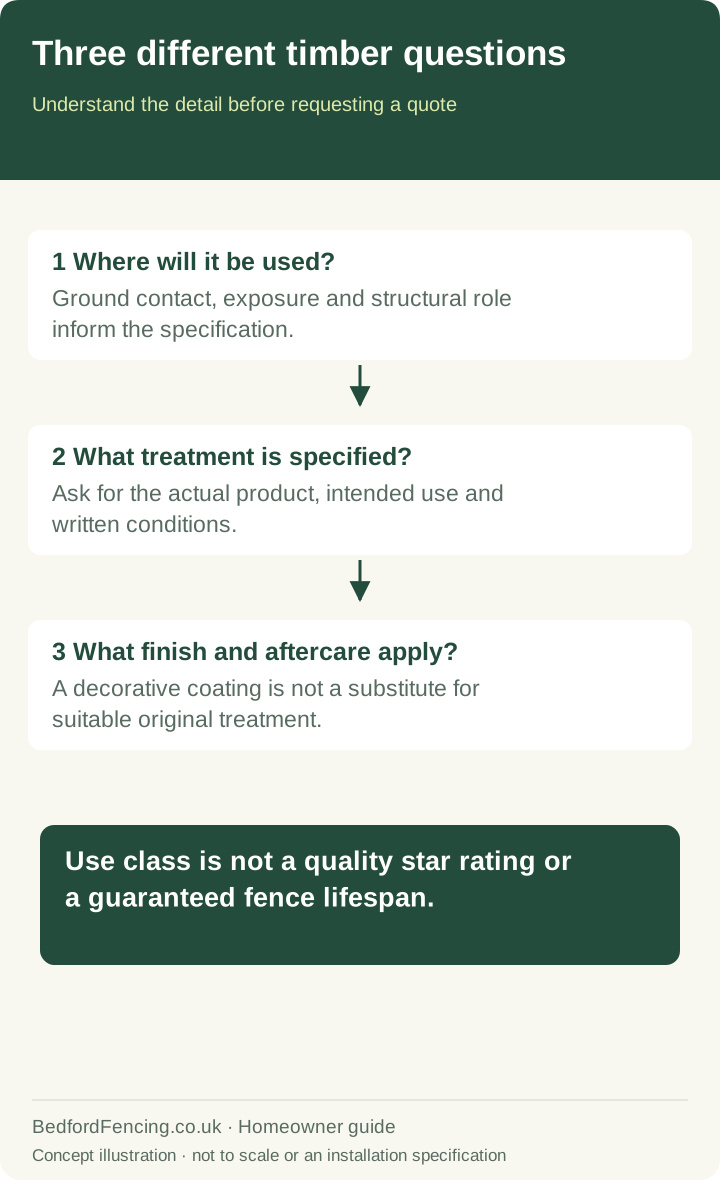
Ask what the component is, where it will be used, which treatment specification applies and what written conditions accompany it. Pressure treatment, dip treatment and a decorative coating are not interchangeable promises of durability.
Why the label on the quote matters
Two timber posts can look similar while being intended for different exposures. One might be suitable for its specified outdoor structural use; the other may have a treatment intended for another application. Colour alone will not tell you which you are buying.
For a homeowner, the useful question is not “Has it been treated?” but “Is this component specified for the job it will do?” A fence contains boards, supports, rails and sometimes a base. They do not all encounter the same conditions, and the quotation should not hide their differences under a single vague phrase.
Keep the supplier's product information with the installed specification. It gives you something concrete to check when discussing maintenance, alterations or a later problem. A verbal reassurance is much harder to revisit once the materials are fitted.
Pressure treatment, dipping and surface finishes
Industrial preservative treatment is designed around the timber and its intended application. The Timber Decking and Cladding Association's preservation guidance describes an industrial pressure process and stresses that protection levels vary. The words “pressure treated” therefore do not, by themselves, answer every question about suitability.
Dip treatment and brush-applied finishes should not simply be assumed equivalent to an appropriately specified industrial process. Ask exactly what a product description means. A stain may be chosen mainly for appearance; a preservative is intended for a different purpose. Products and claims need reading individually.
That distinction is particularly important when someone proposes painting untreated structural timber as a substitute for a suitable original component. A pleasing surface colour cannot establish the protection within the wood or the fitness of the product for ground contact.
Use classes in plain language
| Term | What it helps describe | Question for your supplier |
|---|---|---|
| Use class | The exposure or end-use situation for the timber | Which class applies to this particular component? |
| Treatment specification | What protection is required for that use | What written product information confirms it? |
| Desired service life | A specification objective, rather than an observed life for your fence | What has actually been specified and under what assumptions? |
| Warranty or guarantee | A promise with a scope, conditions and remedy | Who provides it and what costs or failures are covered? |
The Wood Protection Association's preservative-treatment guidance explains that species, application and intended service period affect the specification. Its guidance identifies Use Class 4 protection for timber in permanent ground or fresh-water contact or providing exterior structural support.
Do not turn that into a requirement to select the highest number for every item regardless of use. The point is to choose the right product for the actual application. Use class is not a general star rating for the whole fence or a substitute for checking the structural design.
Species, appearance and incising
A specification may name the timber species as well as treatment. Different timbers do not all accept preservative in the same way. Some treated products have visible incising: small deliberate cuts associated with the treatment process, rather than automatically a defect caused during installation.
The WPA and Timber Development UK's Use Class 4 specification guidance discusses species, penetration and the written information a buyer should request. You do not need to assess the chemistry yourself. You do need the supplier to identify the product and its intended application clearly.
If appearance matters, ask to see a representative sample. Treated timber can vary in colour and texture, and a sample gives a more useful discussion than expecting every delivered piece to match one photograph exactly.
What happens when treated timber is cut?
Cutting or drilling can expose surfaces that need attention under the relevant product instructions. Ask the installer how any necessary modifications will be handled and whether they affect warranty conditions. Do not assume that treatment before delivery means later cutting has no consequences.
The TDCA's cut-end guidance explains the difference between industrial treatment and brush-applied protection. In particular, it warns against embedding a cross-cut end of a treated post in the ground, even after applying end-grain treatment.
This is a specification and installation question, not an invitation to alter components yourself. Keep the manufacturer's current instructions available and ask about suitable purpose-sized parts where extensive modification would otherwise be needed.
Treatment is only part of durability
A suitable timber product still needs a compatible installation. Consider where water, soil and debris may collect, how components meet and whether the fence remains accessible for inspection. The gravel-board guide explains one part of that arrangement.
Posts, panels and fixings form a system. A long treatment promise for one board does not establish that the supports or connections are appropriate. Our post comparison helps you discuss the complete structure rather than use treatment as the only buying criterion.
Where an old post has failed, ask why before fitting another in the same position. Condition, exposure and the proposed installation deserve assessment. A different-looking replacement is not proof that the underlying problem has been addressed.
Does treated timber still need maintenance?
Follow the actual product instructions and distinguish maintenance for appearance from requirements associated with durability or a guarantee. A manufacturer may make different recommendations for cleaning, coatings, inspection and modifications.
If you want a particular colour, ask when and how the chosen finish can be applied to the supplied timber. Avoid generic instructions about painting immediately or leaving every product for an identical period. Read the coating instructions and the timber supplier's guidance together.
Keep vegetation and landscaping in the conversation. A new raised bed or dense plant growth can change the conditions around a fence after installation. If you alter the surroundings, check the effect on the components rather than assume the original specification covers any future use.
What to ask for in a Bedford fencing quotation
There is no universal treatment specification created by the word “Bedford”. The component and its exposure determine the question. Describe your actual garden, including soil contact, established planting, raised ground and difficult access for future replacement.
Ask for component names, relevant treatment information and any warranty conditions in writing. If a claim uses a long number of years, read our fence-lifespan guide before treating it as the expected life of every part of the installation.
- Which timber products and species are being supplied?
- What treatment specification applies to each relevant component?
- How will required cutting, drilling or end treatment be handled?
- What installation and maintenance conditions affect the promise?
- What evidence should you retain if a problem develops?
Use the quotation checklist to compare those answers. The best specification is one you can identify and understand, not simply the most reassuring phrase on the page.
For the separate decorative decision, see painting and staining, and use the seasonal checklist to plan routine care.
Treatment suitability is one part of the wider sourcing, retention and repairability decision.
Premium treated timber: what does a named system add?
A premium timber proposal should identify the supplied timber system, not simply use the word premium. Ask which components are included, what treatment and intended-use specification applies, which installation instructions must be followed and what evidence you receive at handover.
Jacksons’ Jakcure range is one manufacturer example. Its published timber guarantee describes 25-year cover for qualifying failure caused by rot or insect attack. Conditions include registration, appropriate base-board arrangements and specified treatment of site cuts. It restricts altering timber intended for in-ground use after factory treatment.
The remedy is limited to product cost; associated removal, disposal and replacement labour are excluded. Other causes of failure are not automatically covered. Read the full current terms for the actual purchase rather than turning that period into a complete installation guarantee.
This is an example of how to examine a documented system, not an endorsement or a claim that Bedford Fencing installs Jacksons products. Other suppliers should provide their own specification and terms. A shorter promise with a different scope is not directly comparable until you know what each covers.
Compare a standard and premium timber quote fairly
First keep the job constant: length, height, construction, posts, base, gate, removal, access and finish. Then ask what changes between the two proposals. A different panel design or complete post replacement may account for the price difference independently of the treatment system.
- Record the actual manufacturer or component specification.
- Identify intended-use treatment for each component, especially ground contact.
- Ask which site cuts or adaptations are permitted and who follows those requirements.
- Separate manufacturer product cover from contractor workmanship terms.
- Confirm registration, purchase evidence and who handles a claim.
- Compare the complete installed total, not a board price against a whole bay.
For example, if the premium proposal retains old supports, ask how those supports were assessed and which parts remain outside the new product cover. A new guaranteed infill does not renew the rest of the assembly.
Keep the instructions and guarantee with the handover records. The named-system source was checked on 29 October 2026; confirm the terms applying when you purchase.