Timber, concrete or steel fence posts?
An independent comparison of timber, concrete and steel fence posts, including compatibility, installation questions, future repairs and Bedford property checks.
In this guideShow sectionsHide sections
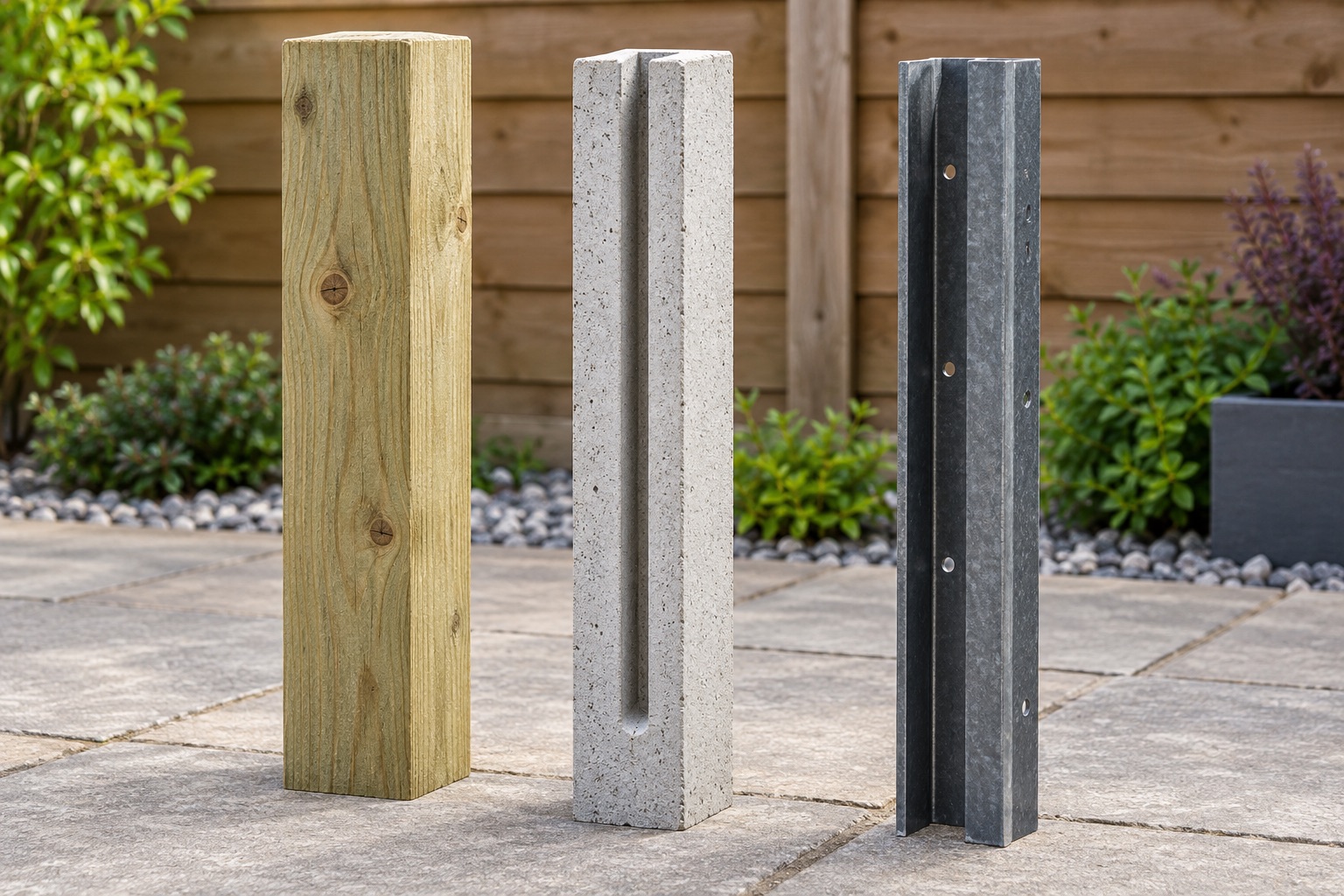
Timber offers a coordinated wooden finish, concrete is often used for slotted-panel arrangements, and steel offers a different profile and fixing system. None is automatically best for every garden. Condition, compatibility, installation and the exact product matter more than a material name.
Why posts deserve attention before you order panels
When you picture a new fence, you probably see the panels. When a fence starts leaning, attention quickly shifts to the posts. They support the visible boundary, determine how components meet and influence what happens when something needs replacing. It makes sense to choose them before the quotation becomes a list of panel prices.
Start by deciding whether this is a new fence or a repair. Replacing panels between sound existing posts is a different project from removing everything and starting again. Changing the post material may also change the fixings, gravel boards and opening sizes. Ask for the complete arrangement to be described, even if you are retaining part of it.
For a broader look at styles, read our garden-fence choice guide. If you already know you want a timber privacy boundary, this comparison will help you ask more precise questions about the structure supporting it.
The main trade-offs
| Material | What may appeal | What deserves a closer look |
|---|---|---|
| Timber | A coordinated timber appearance and a range of construction arrangements | Treatment specification, moisture exposure, compatible fixings and future replacement |
| Concrete | A distinct slotted-panel layout and a mineral finish | Condition, handling, slot dimensions, panel retention and the visual effect |
| Steel | A narrower-looking profile in some systems, with purpose-made fixings | Protective finish, system compatibility, corner details, gates and product-specific instructions |
Use this as a conversation guide, not a ranking. A well-chosen product can be unsuitable if it is paired with incompatible panels or installed without considering the site. Conversely, a material you initially dislike might look different when you see the complete fence and finish.
Timber posts: ask what the treatment actually covers
Timber can make a boundary feel visually consistent, particularly where the boards, rails and posts are intended to read as one design. Different post profiles and fixing methods produce different results. Ask to see the face you will look at from the house, along with the reverse side and any caps or brackets.
The important buying question is not simply whether the wood has been treated. Ask for its treatment specification for the intended exposure. The Wood Protection Association explains why Use Class 4 protection matters for timber in ground contact, frequently wet situations and external structural support. Green or brown colour is not a useful substitute for written specification.
Check the proposed manufacturer’s instructions for installation and any cutting or drilling. Warranty conditions can depend on how the component is used. Keep those documents rather than relying on a verbal promise that “treated posts last for years”. Our source is the WPA’s treated-wood resource centre, which also explains why pressure-treated products should not all be regarded as identical.
Timber appearance changes with weathering and use. Decide whether you want to maintain a particular colour or allow a more weathered finish. Ask what maintenance is appropriate for the specified products; do not assume a decorative coating can correct an unsuitable structural timber choice.
The timber treatment guide explains those specification terms in more detail.
Concrete posts: look beyond the idea of a permanent solution
A slotted concrete post gives a recognisable bay-by-bay appearance, often with a separate gravel board at the bottom. Some homeowners like that clear division; others would prefer the supports to blend into a timber boundary. Look at an ordinary full-garden photograph before deciding whether the finish suits you.
Where panels fit into slots, dimensions and clearances need checking. Ask how the proposed panel is retained and how movement or rattling is addressed under the system’s instructions. Also ask whether there is sufficient access to remove a panel later. A theoretical ability to slide one out may be less helpful beneath an overhang or beside an obstruction.
Concrete still needs an assessment of its condition. A post that is leaning, cracked or otherwise damaged should not be called sound simply because it is not timber. When existing posts are being retained, ask the installer to explain what has been inspected and what remains uncertain below ground.
Handling is another practical consideration. Ask how the components will be brought into the garden and placed safely, especially where access is through a narrow passage or the house. This is part of the installed job, not an inconvenience to discover after buying materials.
Steel posts: compare the actual system
Steel fencing posts come in different profiles and finishes. Some are intended for framed timber panels; other systems have their own infill and accessories. Ask which panels are compatible, how they attach, what happens at a corner and which components finish an exposed end.
A slim profile in a catalogue should be judged in a complete bay. Fixings, cover strips and the gravel-board junction can change the appearance. Request a photograph of the proposed configuration rather than mixing attractive details from unrelated systems.
Protective finishes and installation requirements are product-specific. Ask what the manufacturer says about damage to the coating, cut surfaces, fixings and maintenance. A general claim that “metal cannot rot” does not answer every question about a steel product’s suitability or condition.
For an example of why system details matter, Jacksons publishes information on its steel garden posts. Its profile, compatible components and warranty are examples from one manufacturer, not a specification for all steel fencing. The selected supplier’s current documents should accompany the quotation.
The base needs to match the system too. Our gravel-board guide explains fit, support, ground levels and replacement questions.
DuraPost Classic and Jacksons Mi-T: compare the complete proposal
These are two named steel-post examples, not an exhaustive shortlist or a declaration that one is best for every garden. Bedford Fencing has not tested them or claimed approved-installer status. Ask the business quoting which exact range, finish and infill it proposes.
| Question | DuraPost Classic | Jacksons Mi-T |
|---|---|---|
| What is being compared? | A steel post within Birkdale’s DuraPost system; specify the actual variant and finish. | A T-profile metal post intended for compatible framed timber panels; specify the actual panel and connections. |
| What should the quote name? | Post, finish, infill, base, fixings and the required corner/end accessories. | Post, compatible framed panel, fixings and the exposed-end or base details. |
| What does the homeowner need to see? | The appearance from both sides and how panels, cover pieces and accessories meet. | The front and rear appearance, panel attachment and any visible post or fixing detail. |
| What remains site-specific? | Foundations, exposure, height, access, retained components and any adaptations. A branded post does not design the whole fence. | |
Birkdale’s Classic product page describes a galvanised steel post with different finish options and compatible infill arrangements. That is a starting point for identifying a product, not confirmation that an existing panel or altered layout will work without further checks.
Jacksons’ Mi-T specification identifies a T-profile system and the framed panel ranges it is designed for. Confirm compatibility with the actual proposed panel, rather than transferring that statement to every timber fence or gate.
Why “up to 25 years” needs a second question
Ask: which component, finish, environment and type of defect does the stated term cover? Birkdale’s current DuraPost guarantee makes the period dependent on product and conditions, including finish and environment. It also requires registration within 28 days of delivery with supporting material. Ask who will register the relevant order.
Its published terms exclude associated costs such as installation and disposal from the product remedy. Read the applicable schedules and keep the version supplied with the purchase. A long headline period is not a promise of free removal and refitting of a whole fence.
For Mi-T, obtain the applicable steel-product guarantee and installation instructions, alongside the timber infill’s separate terms. Ask the contractor for its own workmanship terms. A post, a panel and the labour can have different coverage even when they arrive in one installed quotation.
Source check: 29 October 2026. Revisit the manufacturer documents when selecting the actual range. Neither branded example establishes that your future contractor supplies it, holds a particular accreditation or can offer a manufacturer’s terms on an unrelated product.
The material does not design the foundations
It is understandable to want a simple depth or concrete quantity before agreeing a price. The responsible answer depends on the system, finished fence, ground and location. Ask the installer to assess those factors rather than copy a generic dimension from an unrelated product guide.
Jacksons’ timber-post installation instructions, for example, relate hole sizing to the fence height and type and give specific installation details. That is a useful reminder to read the actual instructions for the chosen product, rather than a universal recipe for every post.
Digging also requires attention to buried services. HSE’s underground-services guidance sets out planning, locating and identifying services, and safe excavation. Ask how those matters will be handled. An apparently familiar garden is not evidence that the ground is clear.
Think about the repair you might need later
Ask the installer to describe a future panel replacement and a future post replacement separately. Would neighbouring bays have to be disturbed? Are panels fixed through a frame, held in slots or part of a board-by-board construction? Could suitable components still be sourced if you wanted to extend the boundary?
You cannot guarantee future product availability, but you can keep a record of manufacturer, model, dimensions and finishes. That is more useful than an invoice saying only “new garden fence”. A few photographs of the completed junctions and components can help identify them later.
If the current problem is one damaged post, request a repair assessment before assuming the whole run must go. Our repair-versus-replacement guide explains what information to provide. A repair recommendation should address why the post failed, rather than just make the panel upright for the photograph.
What should a Bedford homeowner add to the brief?
Describe the individual property rather than assume a material is best for the whole town. Mention restricted access, changes in level, established trees and previous movement. Where excavation is close to trees, check Bedford Borough Council’s protected-tree guidance. A post choice does not remove the need to check constraints affecting the work.
Agree the intended boundary position too. HM Land Registry explains that posts and rails are not reliable evidence of ownership. If ownership or the line is uncertain, check the documents and resolve the issue before choosing where to excavate. Its property-boundary guidance is a useful starting point.
Compare installed costs and written terms
Ask for alternatives against the same fence specification. Include the posts, fittings, foundations, labour, old-post removal, disposal and VAT. A post’s shelf price does not describe the work required to replace an existing foundation or bring materials through difficult access.
Our estimator can illustrate a provisional timber-to-concrete upgrade allowance. It does not yet price steel systems; leaving that unpriced is more honest than inventing a universal supplement. Obtain a product-specific written quote for the system you prefer.
Read warranty terms alongside the price. Establish who provides the promise, what failures it covers, any exclusions and whether labour is included. A long component warranty is not automatically a promise to remove and rebuild the whole fence at no cost.
The shortlist to take to an installer
- The fence style, intended finished height and approximate length.
- Your preferred appearance, with a complete-system example if possible.
- Whether existing posts or panels might be retained.
- Access restrictions, trees, slopes and known underground services.
- The product specification, installation method and written warranty you want explained.
Choose the option whose specification and future upkeep make sense to you. There is no need to buy the most expensive post to prove you have chosen well. There is every reason to ask how the complete fence will be supported, installed and repaired.