Closeboard versus overlap fencing: what should you choose?
Compare closeboard and overlap fencing by construction, appearance, repairs and the complete installed specification—not just the panel price.

In this guideShow sectionsHide sections
Closeboard uses vertical feather-edge boards; overlap panels usually use horizontal boards within a frame. For a purchase decision, compare the complete construction and installed specification. A name alone cannot tell you which product will give better value in your garden.
What is the actual difference?
Seen from a distance, both styles can look like a simple wall of timber. Closer up, the direction and arrangement of the boards make them easy to distinguish. Closeboard has narrow vertical boards overlapping along their edges. Traditional lap panels have horizontal overlapping boards, supported by a framework and battens.
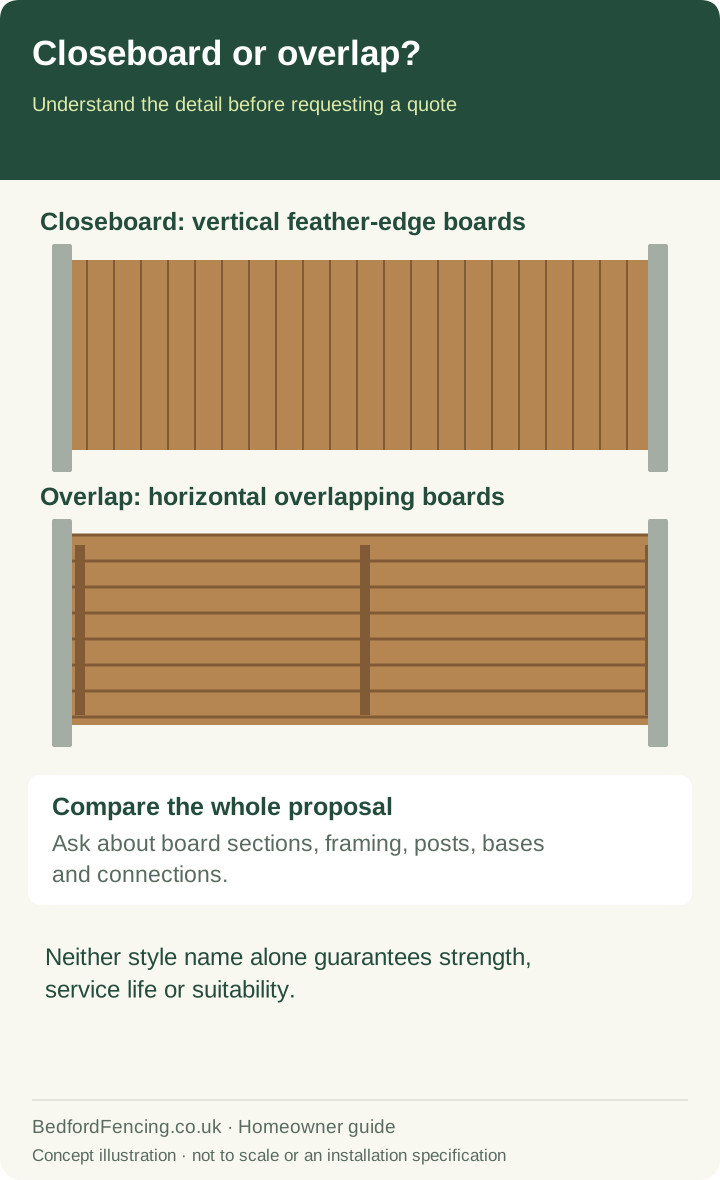
“Feather-edge”, “featherboard” and “closeboard” are often used for the same broad style. Suppliers’ product descriptions still matter because frames, rails, board dimensions and treatment can differ. Ask to see the exact product being quoted, rather than relying on a generic name or photograph.
There is another distinction within closeboard: manufactured panels versus a fence assembled from separate components on site. If two quotes differ significantly, establish whether they describe the same form of construction before comparing the totals.
Compare the job, not just the panel
| Question | Closeboard | Overlap panels |
|---|---|---|
| Typical visible pattern | Vertical overlapping boards | Horizontal overlapping boards |
| How is it supplied? | Manufactured panels or separate components | Usually complete framed panels |
| Budget | Compare the quoted board, support and post specification | Often considered for a lower starting budget, but compare quality and scope |
| Uneven ground | Built-on-site arrangements may offer layout flexibility | Ask how bays, cuts and bottom gaps will be handled |
| Future repair | May involve individual boards or a complete panel | May involve local repair or replacing the panel |
Neither label answers the most important questions about support and installation. A new panel attached to failing posts is not a sound new boundary. Read our post-material comparison alongside this guide if you are choosing a completely new run.
If both proposals are closeboard but one uses complete panels and the other separate components, our construction-method comparison explains the next questions to ask.
Which will look better in the garden?
Vertical closeboard gives a regular upright pattern. Overlap has a more horizontal, layered appearance. The difference can be quite noticeable beside a patio, but much less important behind mixed planting. Look at photographs taken at ordinary garden distance, not only dramatic close-ups of freshly treated timber.
Ask what the reverse face looks like. Frames and supports may be more visible on one side, and that can affect your preference where both faces will be seen. Discuss the orientation before installation rather than discovering the view from your kitchen after the job is finished.
A sample also helps with finish. Rough-sawn timber, planed components and different treatments can look quite different when first supplied. Colour in a product photograph should not be treated as a permanent or exact match, particularly when lighting and the timber’s condition vary.
What should you check when comparing quality?
Turn the panel around. Look at how it is supported, how the boards are secured and how the edges are finished. Ask for the dimensions and number of supporting components in writing. You do not need to become a fence designer; you need enough detail to establish whether two suppliers are quoting the same thing.
Be cautious about absolute claims such as “heavy duty” without an accompanying specification. It is a description, not a complete performance measure. Similarly, a thick-looking perimeter frame does not explain the quality of the boards inside it or the way the whole panel is fixed to the posts.
Manufacturer information is useful here, but it describes that manufacturer’s products. Jacksons’ feather-edge buying guide explains its construction and the distinction between panel and component systems. Its product dimensions or guarantees should not be assumed to apply to every closeboard fence.
Privacy and wind: avoid an oversimplified answer
Both styles are commonly chosen when the aim is a solid timber screen. Ask how the product accommodates normal timber movement and how it looks from the angles that matter to you. “Solid” should not be read as an airtight construction or a guarantee that no small gaps will ever appear.
There is no responsible answer to “Which is stormproof?” based on the panel name alone. Panel construction is only part of a supported boundary. Exposure, height, posts, fixings and foundations need to work together. Explain any previous failures and ask the installer to assess the setting.
If your garden is particularly exposed, do not simply choose a different board direction and assume the problem is solved. Ask whether the proposed system is appropriate and what evidence or manufacturer guidance supports the recommendation. A decorative open system is a separate design decision with different privacy implications.
Which is easier to repair?
Start by identifying what has failed. If a single board is damaged but the surrounding structure is sound, a targeted repair may be worth discussing. If the supports have deteriorated, replacing the visible boards may disguise the problem rather than solve it.
For panelled fencing, ask whether a replacement panel can be fitted without disturbing neighbouring sections. Check access, opening dimensions and the availability of matching products. Do not assume that “standard panel” means every manufacturer’s panel will fit an existing gap.
For closeboard assembled on site, ask how individual damaged components would be accessed and replaced. The answer depends on the construction and the parts available. Our repair-versus-replacement guide helps you describe the affected components without trying to diagnose them from a photograph.
How should you compare costs?
Request prices for the same length, finished height and post arrangement. Keep removal, disposal, gates and VAT on the same basis. Otherwise a cheaper overlap quote might merely omit new posts, or an expensive closeboard quote might include difficult removal work that the other installer has not allowed for.
The cost estimator lets you explore indicative differences between these styles. Its allowances are a budgeting model, not a Bedford market survey or contractor quotation. Use the result to decide what to ask about, rather than to decide that a particular quote must be wrong.
For a short damaged run, compare repair and replacement separately. Replacing a whole boundary because a panel style is discounted may cost considerably more than resolving the original problem. Equally, repeatedly patching a failing system can leave you paying for work that will soon be removed.
Applying the choice to a Bedford-area property
The useful local question is not whether Bedford “prefers” one panel style. It is what your address and boundary require. Before changing height or the nature of a boundary, use the relevant planning authority’s guidance. Bedford Borough Council provides an address-based planning check rather than a rule covering every house in a village.
For the quotation, describe the real access arrangements. A clear run beside an open lawn and a boundary reached through a narrow passage are different jobs. Mention planting that must remain and any need to keep a garden enclosed for pets during the work. None of those details can be inferred reliably from a Bedford postcode.
A sensible way to choose
Put a sample or clear specification for each option side by side. If both meet your requirements, decide whether you prefer the appearance and whether the price difference buys something you value. That might be a particular construction, a compatible post system or a finish you would otherwise pay to change later.
- For an economical like-for-like panel replacement, first establish that the existing supports can stay.
- For an entirely new private boundary, compare the whole fence system rather than the panel price.
- For slopes or awkward end sections, ask how the final layout will be achieved.
- For a garden you plan to change later, ask about future repairs, gates and replacement parts.
If you are still deciding between broader styles, return to the complete fence-choice guide. You do not need to settle every technical detail before a survey. A clear description of the garden and your priorities is a better starting point than a confident choice based only on a product name.