Why fencing quotations differ—and what a cheaper quote may leave out
Investigate price differences through specification, retained components, access, removal and price basis without assuming cheaper means poorer work.
Planning a project? Use our printable measuring and quotation-comparison pack to record your brief and compare written offers.
Check whether the quotations describe the same fence, retained components, removal, access and terms. A cheaper price is not proof of poor work, and a higher one is not proof of better quality. Ask what accounts for the difference.
Do not start by averaging the totals
Three prices can give a false sense of certainty. If they cover different work, the middle figure is not automatically a fair benchmark. Start by identifying the reason each business arrived at its scope.
Perhaps one proposes replacing all posts while another intends to retain them. Perhaps a panel system is being compared with closeboard built on site. Or perhaps one installer has inspected a difficult corner that the others priced from a photograph.
This guide helps diagnose those differences. The quotation-comparison guide provides the sheet to record them; here the emphasis is on asking useful follow-up questions rather than repeating the same checklist.
First suspect: a different specification
A quote saying “timber fencing” leaves too much open. Ask for the product or component specification, finished height, posts, base and fittings. Descriptions such as “standard” or “heavy duty” cannot establish equivalence on their own.
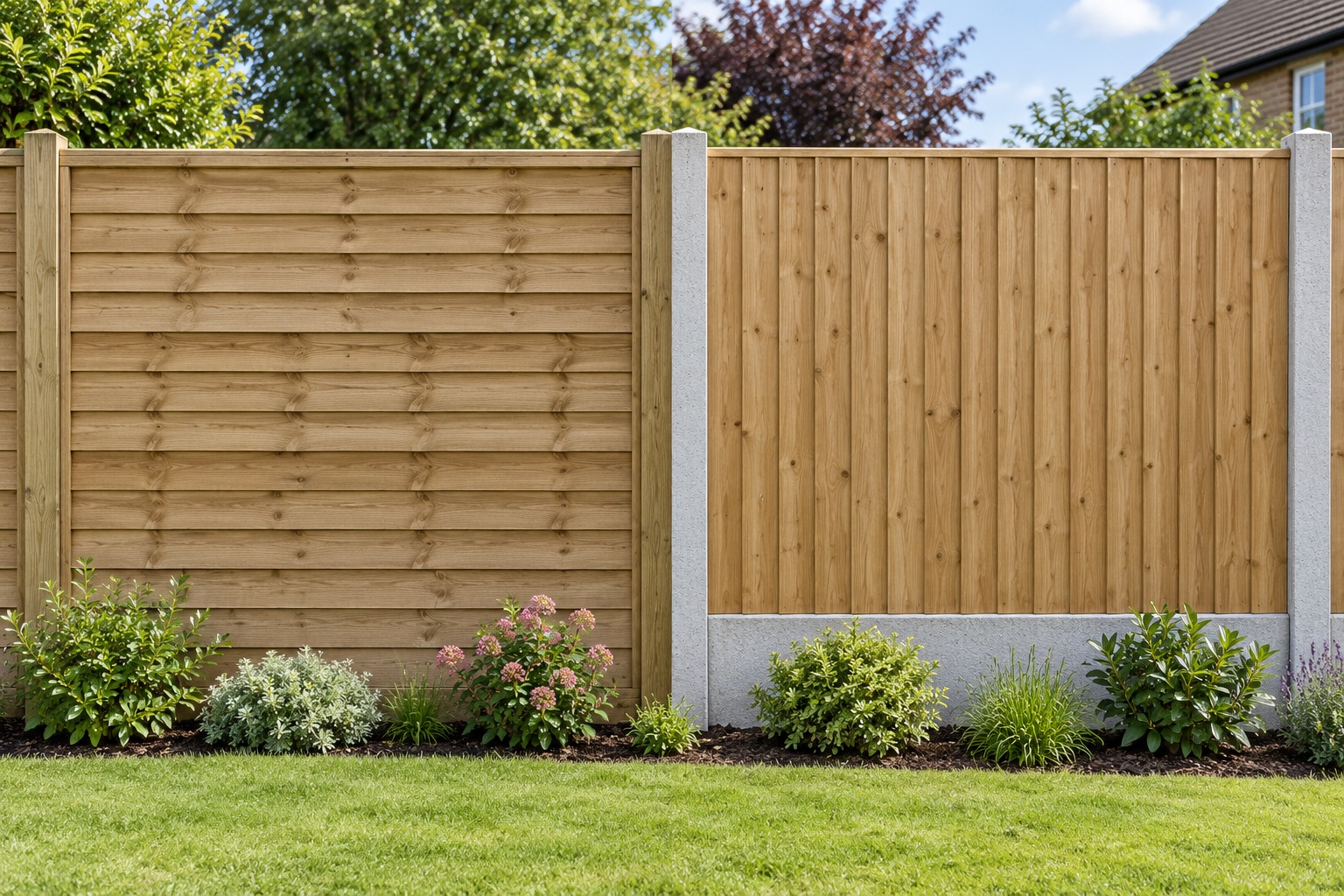
Even within one style, the construction may differ. The style comparison and construction-method guide help identify what is being supplied. If the systems are intentionally different, compare their benefits as alternatives instead of trying to make the prices look identical.
Ask what the difference buys in practical terms. A coordinated finish, a particular post arrangement or easier access for a future repair may matter to you. A more elaborate option may also be unnecessary for the garden's purpose.
Second suspect: what stays in place
Retaining sound components can be a legitimate economy. Retaining unsuitable supports can leave the original problem unresolved. The distinction needs an assessment, not a rule that either everything old must go or everything reusable-looking must stay.
Ask which components were inspected, why they are considered suitable and what limitations remain. If businesses disagree, request the reasoning in plain language. Do not ask them simply to match the cheapest total without resolving the technical difference.
A clear repair option can sit alongside a replacement option. Our repair guide explains how to make those scopes comparable without pretending they are the same project.
Third suspect: work around the fence
Old foundations, awkward access, vegetation, handling and disposal can matter as much as the new panels. A proposal based on a cleared, easily accessed run is different from one that allows for working around retained planting through a narrow entrance.
The removal guide explains why taking down visible timber is not necessarily the whole clearance task. Ask what is excluded for old concrete, skips, ground restoration or separately commissioned work.
If one quote follows a survey and another is preliminary, ask the second business which assumptions need confirming. There is no advantage in comparing a firm assessed scope with a rough budget as if both were complete offers.
Fourth suspect: the unit or price basis
| Price description | What to establish |
|---|---|
| Per panel | Material only, fitted panel, or a bay with supports? |
| Per metre | Which height, system, foundations and removal are included? |
| Day rate | What work, duration, team and materials assumptions apply? |
| Job total | Which exact scope and conditions does the figure cover? |
| Estimate | What remains uncertain and how can the amount change? |
Check VAT treatment before comparing totals. Ask each business for the complete amount payable on its stated basis; do not add an assumed tax charge to a figure already described as inclusive.
Our cost guide explains its own model separately. It is a planning illustration, not a fourth contractor quotation or evidence that a different installed price is wrong.
Follow a hypothetical difference through
Imagine a £1,600 proposal for new panels between retained supports and a £2,000 proposal for new panels and posts, with disposal included. These are invented figures for comparison, not Bedford rates. The £400 gap does not yet tell you whether either business is expensive.
First establish whether the retained supports are suitable. If they are, decide whether renewing them now buys something you value. If they are not, ask for the first proposal to be revised. Then compare the product, base, disposal and finish on the same basis.
If the second quote also includes an optional gate, separate that item. Once the scope is understood, you may discover that part of the difference is a choice rather than a requirement. That is a more useful discussion than a request for an unexplained discount.
Conversely, if both proposals genuinely cover the same work, businesses can still have different operating costs, schedules and commercial approaches. A difference alone is not evidence of dishonesty. Decide using the specification, evidence and terms you can actually check.
How to assess a quality claim
Ask what the business means by better materials or a longer-lasting fence. A named product, treatment specification and written terms are more useful than an adjective. Read the treatment guide and lifespan guide before treating a long guarantee as a promise covering the entire installation.
For installation claims, request relevant examples and an explanation of the proposed method. An attractive finished photograph does not show every foundation or connection, so use it alongside the scope rather than as the only evidence.
The installer-selection guide covers those checks. You are looking for an understandable recommendation backed by relevant information, not a company that answers every uncertainty with a sales phrase.
Send one concise follow-up
List the differences you have identified and ask each business to clarify its own scope. For example: “Please confirm whether the price retains the existing posts, includes removal of old concrete and covers the stated finished height.” Keep the reply with the quotation.
Citizens Advice's guidance for arranging work supports getting clear written details before deciding. If a price changes after clarification, record which scope changed rather than treating the revision as a mysterious new total.
For a Bedford-area property, include known access and planning issues in the shared brief. If one installer was told about a restriction and another was not, give both the same relevant information before making a final comparison.
When the difference still cannot be explained
Ask whether the unresolved point can be checked through a visit, product information or a clearer written scope. If a business will not explain an important inclusion, you may not have enough information to accept its proposal confidently.
Do not let a same-day offer settle a technical uncertainty or leave you agreeing payment terms you have not read. The paperwork guide helps with that final stage.
A useful comparison ends with a reasoned choice. You should understand the work you want, what each alternative offers and why you prefer one. The lowest number may then be the right decision, but it will be a decision about a known project rather than a guess.