Choosing fencing for windy and exposed gardens
Compare permeability, privacy and support requirements for an exposed site without relying on a universal windproof fence claim.
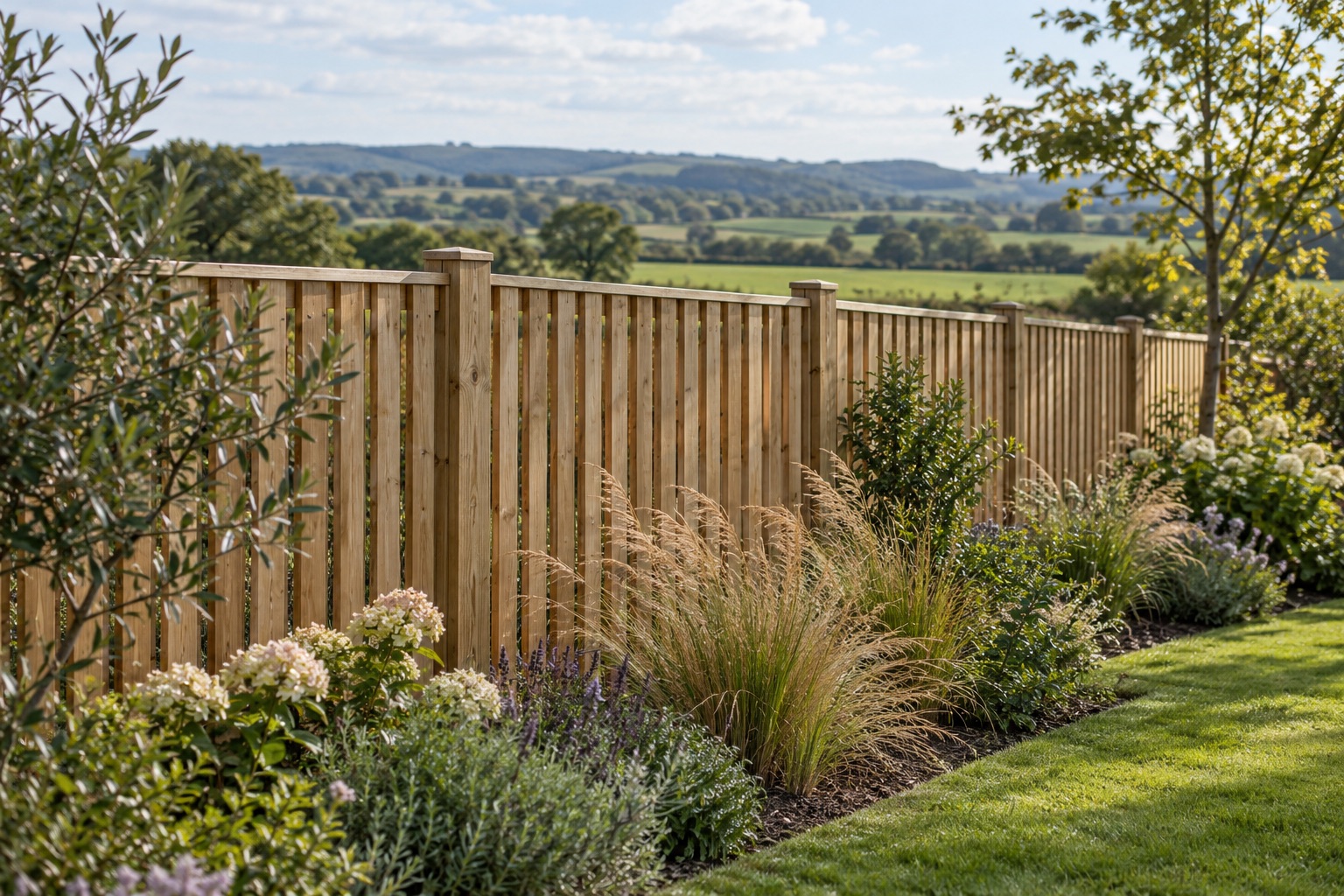
A permeable screen may filter wind, but panel design alone does not establish suitable posts, foundations or connections. No ordinary fence should be described as universally storm-proof.
Shelter, privacy and durability are different aims
You may want a calmer patio, screening from an open view or a boundary less vulnerable than the one that failed. State those aims separately. A design that filters wind may allow views through, while a solid privacy screen presents a different assembly to the wind.
The RHS windbreak guidance explains the sheltering role of semi-permeable barriers and the turbulence associated with solid ones. That gardening principle is not a structural design for a particular fence.
Ask the installer to explain both what the screen is intended to achieve and how the whole assembly suits the exposure.
Describe the actual site
Photograph the wider surroundings: open land, changes in level, building corners and passages that appear to funnel wind. Note where earlier damage occurred and what is known about the old installation.
Do not label every Bedford garden exposed or assume a sheltered neighbouring plot represents yours. Buildings, terrain and the position within the garden can change the conditions. A postcode locates a job; it does not specify the fence.
Our survey guide explains how to turn those observations into a suitable brief.
What does a wind-permeable design offer?
Hit-and-miss, some slatted designs and other open arrangements let air pass through to different degrees. Check the actual construction rather than the style name. Board overlap, spacing and viewing angle affect both permeability and privacy.
For a manufacturer example, Jacksons describes its horizontal hit-and-miss panels as semi-solid and notes that they can be seen through from some angles. That is a product-specific trade-off, not proof that every similarly named fence performs identically.
Ask to see the panel from both sides and oblique angles before choosing it for a seating area. The gap you barely notice in a catalogue may matter from a neighbouring window.
Keep supports and foundations in the conversation
Posts, foundations, fixings, panel dimensions and connections all contribute to the boundary. A lighter wind load does not make any post spacing or foundation adequate. Ask what has been specified and which site assumptions remain.
Use foundation questions and post materials to compare complete proposals. Do not select the apparently strongest panel while leaving its supports undefined.
Where existing posts will remain, ask whether they suit the new assembly and their present condition. An old foundation cannot be declared suitable merely because the previous fence lasted several years.
What will be attached later?
Adding privacy fabric, solid sheets, trellis or dense climbers can change how an open fence behaves. Tell the installer what you intend to add before the design is agreed.
Do not buy a permeable fence for its wind-filtering role and then assume covering all its gaps has no consequence. Our plant support guide covers mature growth and maintenance.
Could a smaller or more targeted screen work?
A limited screen around a seating area may meet the shelter or privacy aim without enclosing every boundary to the same height. Ask for options around the spaces actually used.
Check the full finished height and permissions using the Bedford planning guide. Wind exposure does not create an automatic exception to height limits or authority to alter a neighbour's fence.
After severe weather
Follow safe storm first steps rather than attempting repairs during gusts. Record damage and ask what failed before replacing the same arrangement without review.
Use the maintenance checklist to notice changes between events. Routine checks can identify faults, but they do not guarantee that no fence will ever fail.
Compare two responses to the same exposed boundary
Imagine the existing solid boundary has failed and the main concern is privacy at a table near the house. One proposal might renew the whole solid run; another might combine a more open boundary with a limited screen near the table. These are design alternatives, not proof that either will perform adequately at the site.
Ask each installer to explain the intended shelter and privacy, the support design, retained components and what the proposal assumes about exposure. If a recommendation depends on a named product's test, request the relevant system and installation conditions. A strong panel on undefined supports is still an incomplete offer.
Include planned later changes in that comparison. If the household intends to cover the open fence with privacy mesh, say so now. The option should be assessed in the configuration you expect to use, rather than an open arrangement that will immediately be altered.
Our slatted fencing comparison helps define the privacy trade-off. Obtain appropriate design input where site conditions or the proposed barrier require it; this example is a way to compare briefs, not a wind-load calculation.
What to request in the quotation
- The purpose: shelter, screening, boundary definition or a combination.
- The exact panel or component arrangement and expected visibility.
- Compatible supports, foundations and connections.
- Any retained components and their assessment.
- Permitted attachments and maintenance information.
- Removal, access and the basis for any performance claim.
A credible proposal explains its trade-offs and limits. A broad “windproof” label without a specified assembly and site assessment offers much less useful information.