Picket fencing and open front-garden boundaries
Choose an open boundary that suits the frontage, with practical checks for pale spacing, gate openings, visibility, supports and Bedford property constraints.
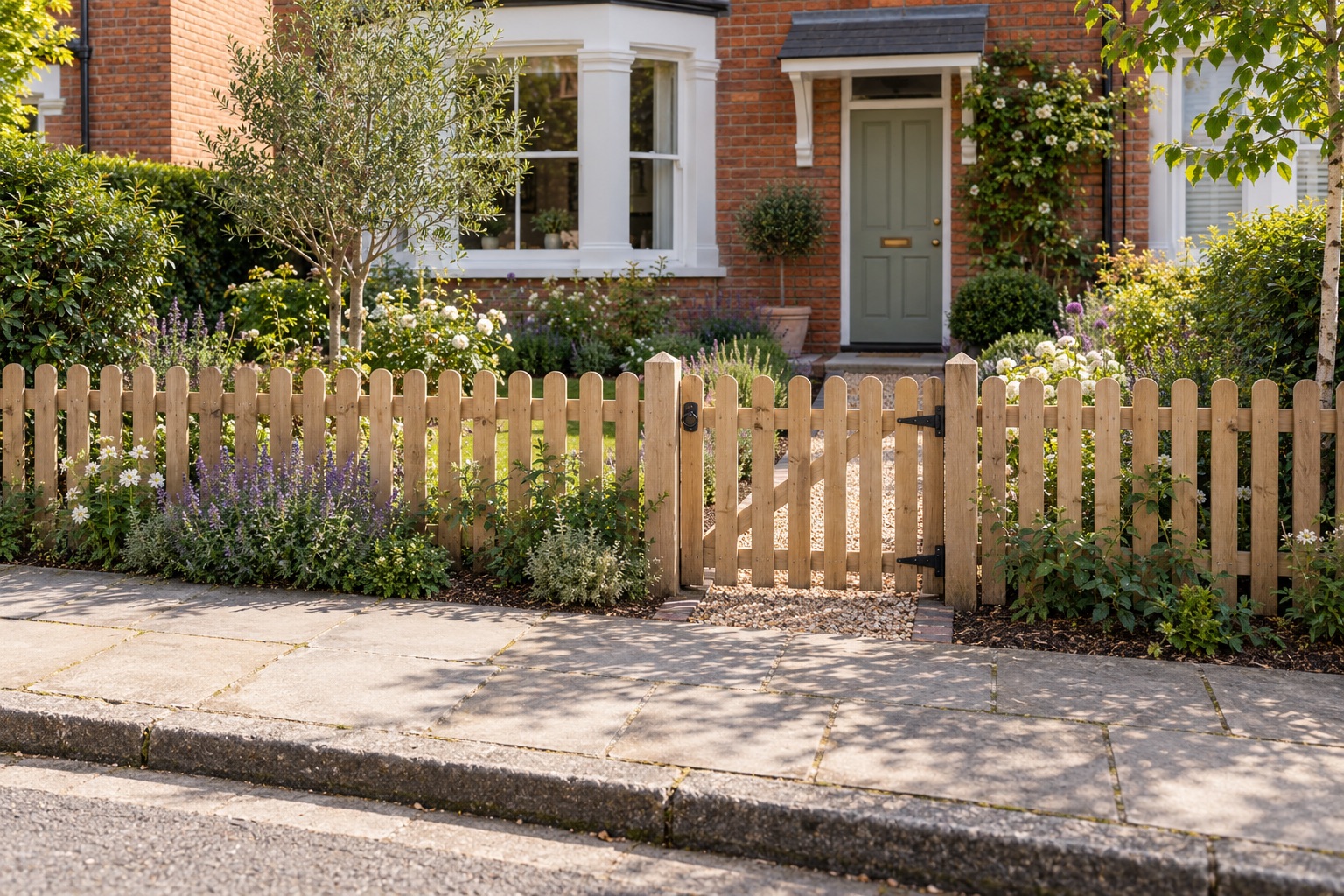
In this guideShow sectionsHide sections
Its open arrangement can suit a front garden, path or internal garden division. Choose the height, gaps, posts and gate around the actual job; a decorative boundary should not automatically be treated as a privacy screen or a secure enclosure for children or pets.
What do you want the front boundary to do?
A front-garden fence has a different role from a private rear boundary. You may want a clear edge beside the pavement, a frame for planting or a gate that makes the route to the door obvious. None of those necessarily requires a solid wall of timber.
Stand at the front door, on the path and beside the entrance. Notice which views you want to keep. A low, open fence may give the garden enough definition while allowing flowers and the house frontage to remain visible. If the real problem is overlooking into a room, the answer may need considering at the window or within the garden rather than simply raising the boundary.
Write down practical requirements separately from appearance: keeping a gate closed, moving bins, seeing people approaching or preserving access for deliveries. That list will help you judge a design that looks attractive in a photograph but might be inconvenient every day.
How a picket fence is made
Timber picket fencing uses upright pales fixed to horizontal supports, with openings between them. It may be supplied as pre-made panels or built from separate components. Round and pointed tops are common styles, but dimensions, treatment and construction vary between products.
Jacksons' picket-fencing overview illustrates panel and kit forms. It is useful for understanding the terminology, not a reason to assume every supplier offers the same bay size or fitting method.
Ask to see both faces and the junction with the posts. A garden viewed mainly from the street may show a different side from the one you see at the kitchen window. Decide deliberately which arrangement you want and include it in the brief.
Picket, rail or slatted: which sort of openness?
| Arrangement | What it offers visually | What to examine |
|---|---|---|
| Picket pales | A repeated upright pattern with views between | Pale spacing, top shape, frame and matching gate |
| Post and rail | A more open outline | Whether the large openings suit the intended use |
| Open slatted screen | A more linear, contemporary pattern | Views from an angle and how the reverse face looks |
| Fence with planting | A softer edge that changes through the year | Mature plant size, access and the winter appearance |
For a purely visual boundary, an open arrangement may be enough. For containment, the openings and gate become central to the specification. Those are different tasks, so avoid using “secure” as a catch-all description without explaining what you need to keep in or out.
Keep height and visibility in the same conversation
A taller fence can alter how the front garden relates to the street. Look along the frontage as well as straight at the house: a design can feel light from one angle and surprisingly enclosed from another.
Roadside visibility needs particular attention around entrances. Do not choose a fence height solely by matching a neighbour's installation. In England, the ordinary permitted-development rules distinguish a boundary adjacent to a highway used by vehicles from one elsewhere, and exceptions apply. Our Bedford planning guide explains the checks and links to the official guidance.
For the design itself, read choosing fence height. The aim is to select a useful arrangement within the applicable constraints, not automatically build to the greatest height that might be allowed.
Design the gate with the fence
A matching gate needs more than similar-looking pales. Check the clear opening, supporting posts, hinges, latch and how the gate moves over the ground. Measure the things that regularly pass through, including bins and gardening equipment, rather than choosing the nominal gate width from a catalogue.
Think about daily use. Can someone carrying shopping reach and operate the latch comfortably? Where does a visitor wait? Will planting, a step or an uneven surface interfere with the swing? Describe those conditions to the installer before the layout is fixed.
If gate control matters for a child or animal, discuss that specific requirement and the limitations of the chosen arrangement. Ordinary decorative fencing is not a substitute for supervision or a specialist safety enclosure. Do not infer a safety certification from the shape of the pale tops.
Posts, treatment and the bottom edge
The fence's lighter appearance does not remove the need for suitable support. Ask how the chosen panels or rails attach to the posts and how the layout handles ends and corners. The complete system should be compatible; a leftover post is not necessarily suitable because its colour matches.
For structural timber and components exposed to ground contact, ask for the appropriate treatment specification. The Wood Protection Association's treated-wood resources explain why a simple “pressure treated” description is not the whole specification.
Discuss the clearance and maintenance detail at the bottom. Grass, soil and planting change over time. Leave an arrangement that can be inspected and maintained without routinely dismantling the fence. If a base board is proposed, our gravel-board guide explains the questions to ask; not every open design needs the same detail.
Let planting complement the fence
Think about the size of plants after they establish, not just the neat nursery pots beside a newly installed fence. Dense planting can obscure a gate, occupy a path or make a previously open boundary feel solid. Decide which views and access points should stay clear.
The RHS discusses how planting and boundaries can work together in its garden-screening advice. Use the idea of balancing views, shelter and privacy rather than treating every gap as something to fill.
Where planting already exists, agree what stays and how it will be protected during the work. An installer cannot reliably allow for careful working around established shrubs if the initial brief assumes a clear strip of ground.
The Bedford frontage checks
For a property in Bedford Borough, use the council's planning-check process before changing an open frontage. Look at the relevant property history and constraints rather than assuming that every house on a street has identical rights.
If heritage controls may be relevant, the council's historic-area information is a starting point for finding applicable records. Our approximate service radius does not determine the responsible authority, so confirm that separately for an address outside the borough.
Also establish the intended boundary position and who can authorise the work. Planning checks do not settle private ownership. Read which fence is mine? if that remains uncertain.
What to include in a picket-fence quotation
- The run lengths and the desired finished height.
- The actual panel or component system, pale shape and spacing.
- Posts, supports, compatible fixings and treatment.
- The gate opening, support arrangement and fittings.
- Removal, disposal, access, planting protection and VAT.
- The agreed appearance from both sides and any finishing work.
The current cost estimator covers selected solid and slatted timber options, not a priced picket system or gate. Do not substitute a different style in the calculator and treat the total as a picket quotation. Request a written scope for the design you want, then use our comparison guide to assess the alternatives.
A well-chosen front boundary should make the garden easier to understand and use. If it preserves the views you value, works around the entrance and has a specification you can maintain, it does not need to be tall or elaborate to earn its place.
At an entrance, use our roads, paths and driveways guide to prepare the location and visibility checks.
Compare gate styles and construction sketches before specifying the leaf, opening and fittings.