Garden gates compared: styles, construction, openings and fittings
Compare gate construction and styles with illustrated examples, then plan openings, driveway pairs, slopes, supports, fittings and aftercare.
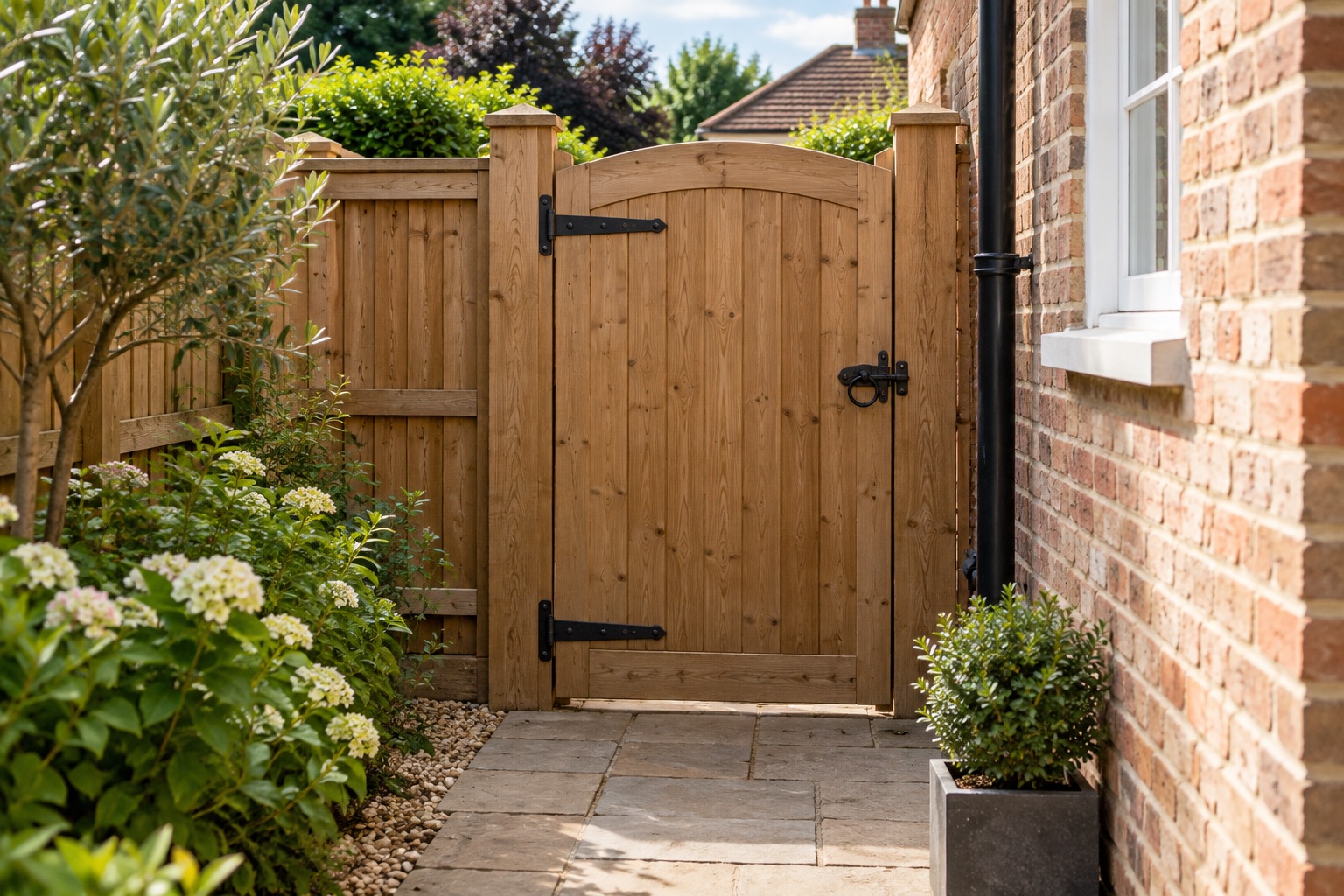
The gate leaf, hinges, latch, posts and foundations form one assembly. Specify the complete arrangement and check the route people and equipment need to use, not just the gate's catalogue width.
Recognise the gate before comparing prices
Gate descriptions mix three different things: how the leaf is built, what fills it and what it is used for. They are not five competing products. A pedestrian gate can be framed, ledged and braced, with tongue-and-groove boarding, all at once.
The sketches below identify the visible ideas only. They are not construction drawings, fixing instructions or evidence of structural performance. Use the selected supplier’s specification for the actual assembly.
Rear-view sketch: horizontal ledges and a diagonal brace support the boards. Ask about the actual joints, fixings and supplied hanging direction.
Rear-view sketch: a perimeter frame surrounds the infill; ledges and bracing may also be present. “Framed” describes construction, not a security rating.
Front-view sketch: closely fitted vertical boards give a solid appearance. This describes the infill and can be combined with a framed, ledged-and-braced leaf.
An open picket example. “Pedestrian” describes the access purpose: the same opening could have solid, slatted or other suitable infill.
Two leaves meet across a vehicle entrance. Plan both leaves, everyday access, stops, fittings, supports and the complete opening.
What do ledges, bracing and a frame change?
Ledges are the horizontal members behind the boards. Bracing helps the leaf keep its shape, while a perimeter frame is another construction feature to compare. The timber sections, joints and connections matter as much as those words in a product name.
Ask to see both faces and the supplied hanging instructions. A photograph of the smooth face hides much of the construction. Do not reverse a gate or move its hardware simply because the other face looks better; confirm the intended orientation with the supplier.
Jacksons’ Brook and Crundale specification provides a useful product example combining framing, ledges, bracing and tongue-and-groove-effect boards. It illustrates why these descriptions overlap. Its dimensions, fittings and guarantee apply to that range, not every gate described similarly.
For boarding, distinguish a real joint profile from an appearance described as tongue-and-groove effect. Ask what is supplied and how it is assembled. A solid appearance does not establish acoustic performance or a tested security level.
Pedestrian access or a vehicle entrance?
A pedestrian gate should work for the people and equipment using the route. A driveway opening introduces a different layout: the width and approach for vehicles, where each leaf swings, how leaves are held open and what happens at the meeting point.
With a pair, ask whether both leaves open on an ordinary day or one acts as the usual pedestrian entrance. Unequal leaves or a separate pedestrian gate may be alternatives to discuss, but they need their own layout and price. Avoid having to release a whole vehicle entrance just to take the bins out.
Show vehicles, paving, steps, slopes and any public route on the sketch. Keep the available approach space separate from the gate’s nominal width. A vehicle that fits between the posts in a straight line may still need room to turn into that line.
Heavier or wider leaves also change the support question. Do not assume existing brick piers, a wall or an old fence post can carry them because they look substantial. Ask for an assessment of the actual supports and connections; specialist input may be needed.
Compare the complete fittings package
| Item | Question to settle |
|---|---|
| Hinges and fixings | Are they specified for this leaf, support and environment, and included in the price? |
| Latch and lock | Who can operate it from each side, and does the normal routine keep the gate closed? |
| Stops and hold-open arrangements | How are open and closed leaves controlled without obstructing the route? |
| Second-leaf fittings | How is the less-used leaf secured and released, and what ground detail is required? |
| Finish and aftercare | Which care instructions apply to the timber, coating, metalwork and moving parts? |
Ask for product references where a particular fitting matters. A lock fitted to one component does not turn the whole boundary into a certified security system. For children or pets, explain the actual need rather than assuming a common latch provides specialist containment.
What needs to pass through?
List normal use: people carrying shopping, bins, bicycles, a mower or mobility equipment. Consider occasional access too. A gate that looks generous may leave a smaller clear opening once posts and hardware are included.
Measure the existing opening and state the endpoints. If the new layout can change, describe the opening you need rather than treating the old dimensions as compulsory. Our measurement guide explains nominal and actual dimensions.
Agree the swing and surrounding space
Decide the hinge side and opening direction using a drawing or view from a defined side. “Left opening” can mean different things to two people facing each other.
Check steps, walls, downpipes, planting and space to stand while operating the gate. An opening should not obstruct a shared or public route. If access rights are involved, confirm them separately.
On a slope, a gate can foul rising ground or leave a larger bottom gap in another position. Jacksons' slope guidance illustrates the issue. Do not assume a ground alteration is automatically acceptable or included.
Supports are part of the purchase
A gate's repeated movement and weight need suitable supports and connections. Ask whether existing posts can be retained and what condition and foundation assumptions that relies on.
Use foundation questions before comparing a complete installed gate with the price of a bare leaf. Attaching a gate to an unknown wall or an old fence post needs assessment.
Specify any latch post, stop and junction with adjoining fencing. The assembly should be understood before materials arrive, not improvised from whatever space remains.
Solid, open and matching designs
A solid gate may offer more visual privacy, while an open design can preserve views. Consider wind exposure, the appearance from both sides and compatibility with the surrounding fence.
Matching colour at delivery is not a promise that new timber and retained weathered fencing will look identical. Choose whether functional compatibility or a fully uniform appearance matters most.
For a frontage, use road and entrance checks. A gate is part of the finished boundary, not a height-limit exception.
Latches, locks and daily operation
Discuss who uses the gate, whether access is needed from both sides and how it is kept closed. A secure lock is not useful if the normal routine leaves the gate open or forces users to climb over it.
Ask about corrosion resistance, suitable fixings and maintenance for the actual hardware. Confirm what is supplied and whether keys, stops or other fittings are included.
For dogs or children, explain the purpose clearly using our dog and family-garden guides. Do not assume every domestic latch is a certified safety device.
Powered gates are a different scope
If automation is proposed, obtain appropriate specialist design, installation, safety assessment and servicing. Adding a motor is not an ordinary decorative extra to a pedestrian-gate quotation.
HSE explains that powered gates need appropriate design, installation, documentation and maintenance. The requirement concerns the complete machine, including a manual gate being converted to powered use. Obtain competent specialist advice rather than treating automation as a motor added to any timber leaf.
This guide is not a powered-gate commissioning procedure. Ask who will assess the installation, provide the operating and emergency instructions, demonstrate safe use and specify servicing. Do not assume adding a sensor alone resolves every hazard.
Test the proposed layout against an ordinary day
Imagine returning with a bicycle while another person is standing on the path. Where does the gate swing, where can you stand and can you reach the latch without awkwardly leaning around the post? Repeat that thought exercise with bins and anything else that regularly passes through.
A wider leaf may seem the obvious answer, but ask what it changes about support, weight and swing space. If two leaves are proposed, establish which opens for everyday use and how the second is secured. Do not compare two different arrangements simply by their combined catalogue width.
For mobility needs, explain the required passage and operating routine to the supplier. Allow for the approach and threshold as well as the opening. A product described as accessible still needs to work in its installed setting; an awkward turn immediately behind it can defeat an otherwise generous width.
Allow for later changes without buying unnecessary extras
Ask whether replacement hinges, latches and other fittings are identifiable and available. Keep the model information rather than just a photograph of the finished gate. If a particular lock or closer is essential, have it included in the written specification.
Discuss aftercare around the actual product. If the gate starts catching, record where and when rather than immediately trimming the leaf or adjusting every fitting. Ground movement, support movement and timber changes are different possible issues; the installer should assess the cause before a repair is chosen.
Agree how to report a problem and what the written terms cover. A gate being handmade, treated or fitted with a lock does not by itself establish a particular guarantee or security rating.
What should the quote include?
- The clear opening and gate-leaf dimensions.
- Material, style, finished height and viewing orientation.
- Hinge side, swing direction and ground clearance.
- Posts, foundations, fittings, lock and stop.
- Removal, access, service checks and making-good.
- Use restrictions, maintenance and written terms.
Our new-fence estimator excludes gates. Ask for a separate installed price reflecting the whole assembly.
At handover
Have the installer demonstrate operation when the assembly is ready for normal use. Check the agreed opening, closure and lock without forcing the gate. Keep product details and report any persistent dragging or movement.
For a Bedford-area enquiry, photographs of the approach and ground are as useful as a preferred gate picture. A practical gate should fit the household routine and site, as well as the fence style.