Fence panel replacement costs versus a complete new fence
Compare panel-only replacement with a new fence, understand published UK price context and check supports, access, removal and quote inclusions.
In this guideShow sectionsHide sections
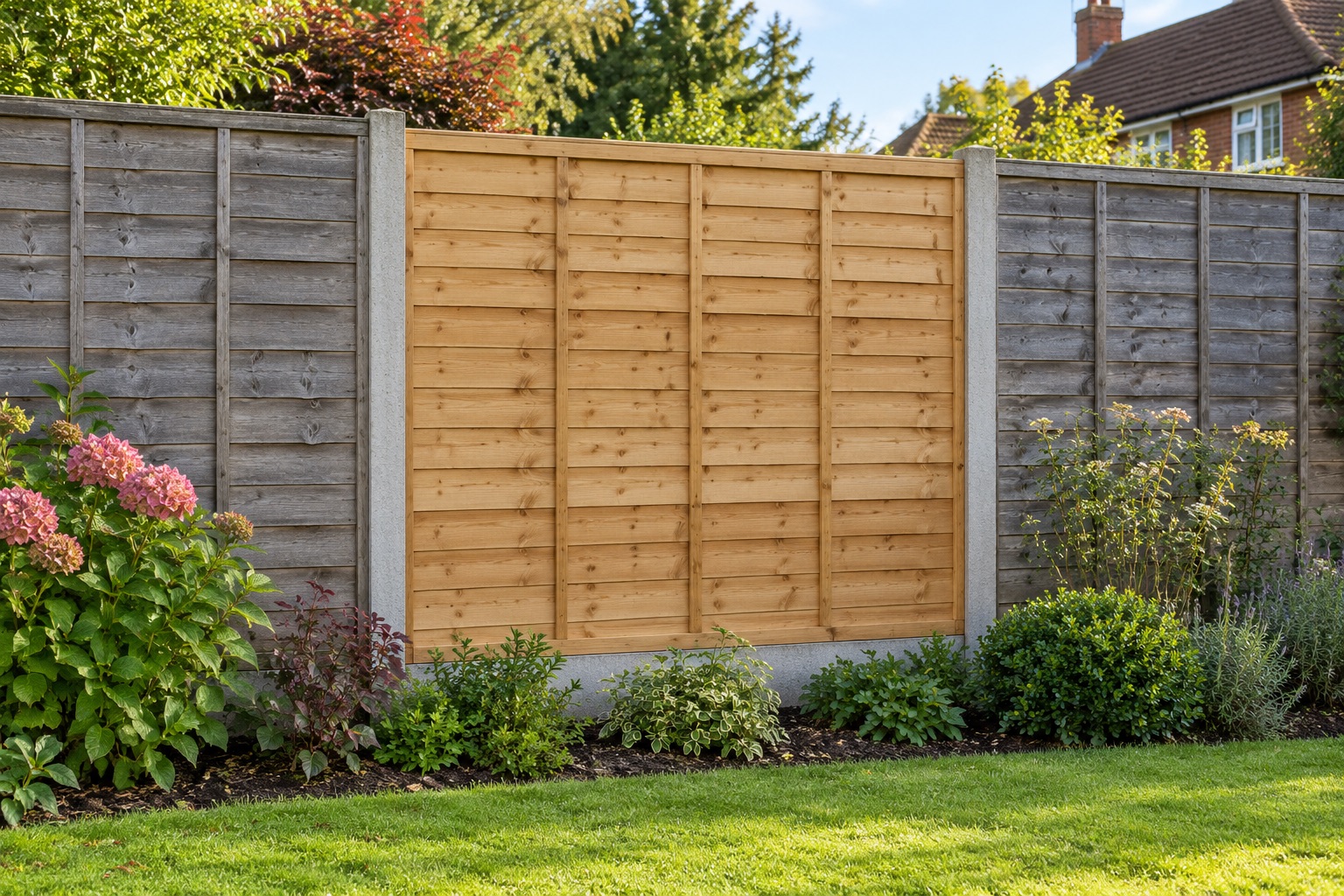
For initial context, MyBuilder's UK garden-fence guide lists single lap-panel replacement at £100–£150 and closeboard at £110–£150. These are published indicative figures, not Bedford quotations. Confirm the exact scope, access, disposal and VAT treatment before using any range as your budget.
This page explains the budget and quote scope. For the condition, fit and access checks before replacing a single bay, use can you replace just one panel?.
First, define what “panel replacement” means
You may only want the damaged timber unit removed and a compatible one fitted between the existing posts. Another quote may include new posts, base boards or foundation work. Both might be described casually as replacing panels, yet their prices cover quite different amounts of work.
Ask whether the supports have been assessed as suitable to retain and which connections need renewing. A panel can be the most visible damaged part without being the only problem. The repair-versus-replacement guide helps identify what needs an assessment before you compare costs.
Do not assume that a new panel will make a leaning run sound. If the supporting post is affected, read the post-replacement cost guide and request the work as a separate, clearly described option.
What do public price guides actually tell you?
| Published item | Indicative figure | How to use it |
|---|---|---|
| Single lap-panel replacement | £100–£150 | A starting question about the scope of a small replacement |
| Single closeboard-panel replacement | £110–£150 | Check the actual product and retained supports |
Source: MyBuilder's garden-fence cost guide. Published tables can mix panels, bays and complete replacement arrangements. Ask which unit and inclusions apply rather than treating every similar-looking number as comparable.
These figures do not establish a local average, a minimum price or an offer to complete your job. A small repair can involve setup and travel disproportionate to the amount of new timber. Several straightforward panels may share some of that work, but do not assume a fixed discount per additional panel.
The parts of the installed price
A useful quote identifies the new product and the work needed to fit it. Delivery, removal, handling and new fixings may matter as much as the shelf price of the panel. If a post, base or rail needs replacing, keep that additional scope visible.
- The actual panel dimensions and construction.
- Delivery and getting components into the garden.
- Taking down the old panel without damaging retained parts.
- Suitable new connections or compatible fittings.
- Agreed removal of waste and finishing work.
- The complete price and stated VAT treatment.
Our quotation-comparison guide provides a fuller checklist. You do not need an itemised price for every nail, but you should be able to explain what the total buys.
Matching the opening can change the work
A product sold as a standard panel still needs checking against the actual opening and support arrangement. Width, frame thickness, slots and fixing details matter. Do not buy materials from a rough panel count and assume the installer can make every unit fit without extra work.
If a panel needs adapting, ask how the new edge will be finished and supported. If the opening or post position has changed over time, the task may go beyond a simple exchange. Our measuring guide helps you record the dimensions without presenting them as a final order.
Closeboard and overlap have different constructions, and product quality varies within each description. Use the comparison guide to identify what a price difference is actually buying.
Access can matter more than the number of panels
A panel next to a clear side entrance and one behind a shed may require different handling. Describe narrow turns, steps, routes through the house and anything above the fence that could affect removal. Include the route for taking the old panel away, not just bringing the new one in.
Ask whether planting must be moved and who is responsible for that work. If plants must stay, the installer needs to price the available working space. Avoid a quote based on a cleared boundary if that is not the garden you will provide.
Where access relies on neighbouring land, agree that arrangement beforehand. Our ownership guide helps separate permission to alter the structure from an assumption that access is automatically available.
The moment it stops being a panel-only job
If the survey finds an unsuitable post, damaged base or failing support connection, ask for the revised scope before additional work proceeds. Keep the original panel-only proposal and the change clearly distinguished. That lets you compare a targeted repair with a wider replacement honestly.
The gravel-board guide explains why a base is part of a compatible system. New boards and panels should not simply be squeezed into a layout whose support details have not been assessed.
A component-built fence may involve replacing individual boards rather than a whole manufactured panel. Read the construction-method guide before assuming the word “panel” describes your existing fence accurately.
Two realistic budgeting conversations
In a hypothetical straightforward case, one damaged panel is accessible and the installer finds the supports suitable to retain. The quote names the replacement product, its fitting and disposal. Published small-repair ranges are useful context, but the written scope is the actual offer.
In a second hypothetical case, two panels are damaged beside a leaning post. One business prices only the visible panels; another includes renewing the support and dealing with the foundation. Comparing their totals without recognising that difference would favour an incomplete answer to the problem.
Ask each business what has been assessed and what remains provisional. Do not use a calculator total or the lowest published number to pressure an installer into an unspecified repair.
Bedford details to include with the enquiry
Send wide and close photographs taken safely from your property, the approximate number of affected units and an access description. Mention any intended change in height or appearance rather than assuming it is part of a like-for-like replacement.
Use the Bedford planning guide where the proposal raises permission questions. Property history and constraints can matter even when the visible work seems small. The appropriate authority depends on the address, not our service radius.
Why the main estimator is not a panel-repair calculator
Our estimator models a new installed run with new posts. It does not assess retained supports or price the setup for a one-panel repair. Entering the width of one panel does not turn the result into a replacement quote.
Use it for the broader alternative if you are considering a new run. For the repair, request a written assessment-based price. Keeping those two questions separate makes the figures more useful and the eventual decision easier to explain.
Our reuse guide explains the condition and compatibility questions behind a retained-post panel replacement.
For the practical fit and access checks behind the price, see replacing just one panel.