Can you replace just one fence panel?
Check a single-panel repair for support condition, actual dimensions, fit, access, appearance and a complete installation and removal scope.
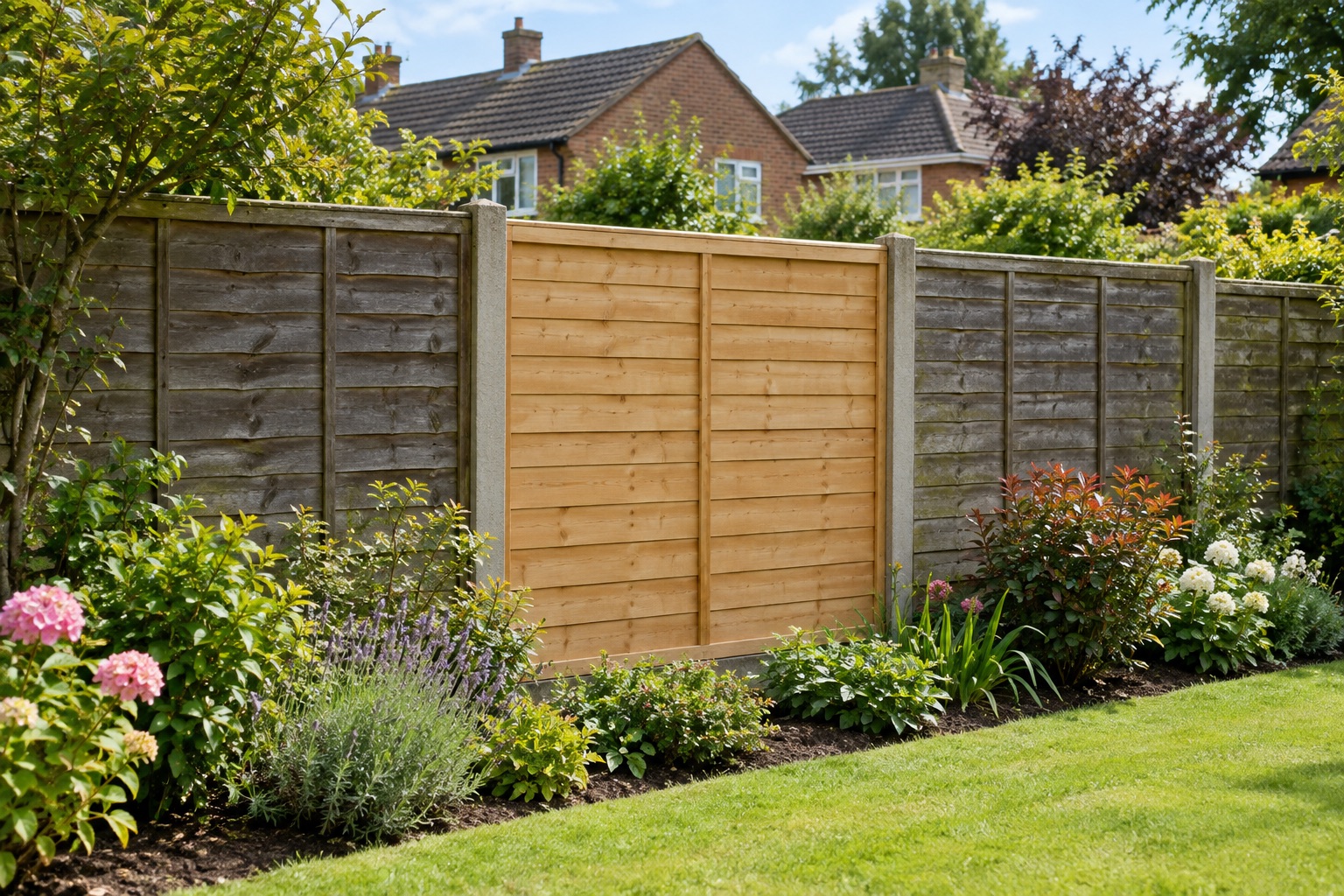
Check the actual opening and replacement product, access and the cause of the damage. A matching nominal size or similar photograph is not enough to confirm that a new panel will fit.
Is the panel the only fault?
A broken board or damaged frame can be a local problem in an otherwise useful fence. Equally, a panel may have failed because its supports moved or connections deteriorated. Begin with the cause, not the shopping list.
Describe which bay is affected and what happened. Include a wide photograph and closer accessible views, taken without moving unstable parts. If a post leans or several bays are loose, ask for the support arrangement to be assessed before specifying a panel-only job.
The repair decision guide covers the wider comparison. This guide concerns a targeted replacement where retaining the surroundings may be reasonable.
Measure and identify the existing arrangement
Record the panel style, approximate height and accessible dimensions. State whether you measured the panel itself, the clear opening or another reference. Posts, slots, brackets and frames can change what fits.
Our measurements guide explains nominal sizes and bays. For a real product example, Jacksons lists actual dimensions for its panel range. Those are product specifications, not a guarantee of compatibility with existing concrete or timber posts.
Ask the supplier or installer to confirm the selected item against the actual opening and fittings. Keep a product reference for future repairs rather than relying on a description such as “standard six-foot panel”.
Check posts, bases and fittings
Retained components need suitable condition and alignment. Ask which ones will stay and what has been assessed. A new panel should not be expected to stabilise a failing post or compensate for an unsuitable foundation.
Confirm the base arrangement and finished height. Changing a base board as well as the panel may alter the result even if the panel label sounds the same. Our retention guide covers those assumptions.
Where old fixings or connections cannot be reused, include appropriate replacements in the scope. The quotation should say how the panel will be supported and secured, not just which panel will be delivered.
Can the panel be brought into place?
A slotted-post arrangement may need clear space above to remove and insert a panel. An overhanging roof, branch or other structure can change the method. Ask the installer to check this before treating the replacement as a simple swap.
The delivery route matters too. A complete panel may be awkward around tight corners or through the house. Our restricted-access guide helps describe the full route, including removal of the old panel.
Do not climb onto the fence or remove overhead obstructions yourself to make a replacement possible. Agree a suitable method and any necessary permissions or specialist work.
Will one new panel look different?
Usually it will, particularly beside weathered timber. A functional repair does not require every bay to have identical colour. Decide whether the contrast is acceptable before paying to replace sound sections purely for appearance.
Manufacturer guidance on timber weathering explains why colour changes over time. Do not promise that different ages or products will become an exact match on a particular date.
If a finish is proposed, check coating compatibility and permission where the structure belongs to someone else. Painting is a separate decision from proving that the repair is suitable.
What if the original panel is unavailable?
Ask for a compatible alternative or a clear explanation of the necessary adaptations. Construction, thickness, support details and finished appearance all matter. Not every panel can be cut down or modified in the same way.
For component-built fencing, the sensible repair may involve individual boards or rails rather than a complete panel. Our construction comparison helps distinguish those cases.
If adaptation becomes substantial, compare its full cost with a defined section replacement. Do not extend the job automatically, but understand what each option leaves behind.
What should a single-panel quotation include?
- The replacement product and verified dimensions.
- The posts, base and fittings to retain or renew.
- Safe removal and installation, including access constraints.
- Appropriate disposal of the old material.
- The complete payable price and any assumptions.
- A process for hidden faults discovered during removal.
Use the panel cost guide for budgeting context. The whole-fence estimator does not price this repair. For a Bedford-area enquiry, send the postcode, safe photographs and access details so the installer can assess whether a targeted replacement is worthwhile.