Fence or hedge: which suits your garden boundary?
Compare privacy, space, establishment, wildlife, maintenance and access before choosing a fence, hedge or combined boundary.
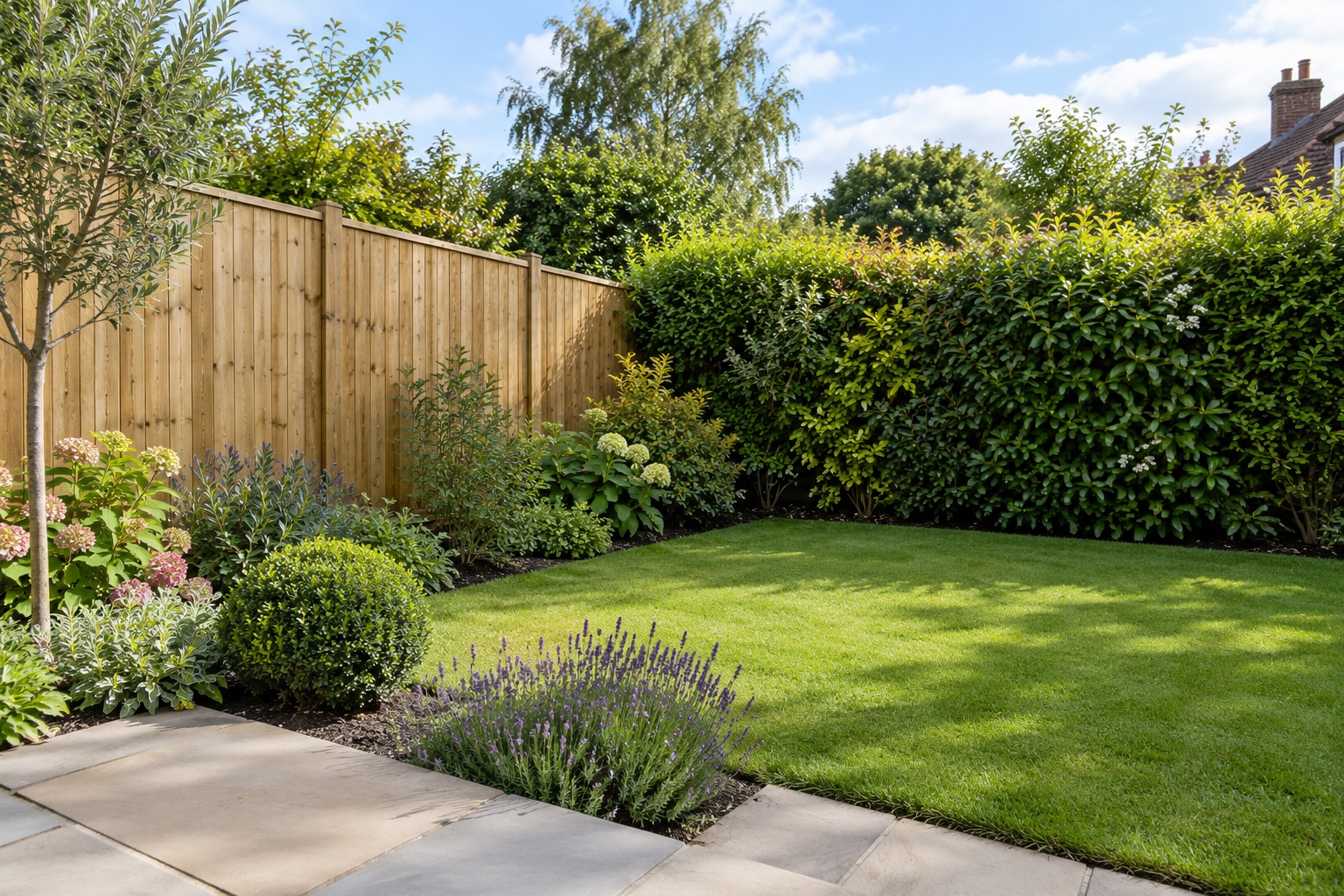
Compare privacy, space, access, wildlife, maintenance and the full lifetime task. A combination may work, but it needs planning rather than treating plants as an automatic substitute for every fence function.
Start with the function
Do you need immediate privacy, a defined frontage, shelter for plants or a dependable managed enclosure? List the essential outcomes and when they are needed. A hedge that may eventually provide cover is a different proposal from a completed fence at handover.
Neither option removes the need to identify ownership and relevant rights. Replacing an established hedge with fencing is also a clearance project, not simply a materials swap.
Allow for the mature boundary
A hedge needs room for its intended width and maintenance. Check the species and cultivar rather than assuming every hedge can remain thin. Leave a realistic route for clipping and avoid obstructing paths.
A fence occupies space too, including posts and foundations, but its visible footprint is usually defined at installation. Compare actual layouts rather than a narrow line for one option and a mature photograph for the other.
The RHS hedge guidance explains choosing plants for the site and intended style. Do not assume a fast-growing plant is automatically the lowest-maintenance choice.
Privacy and seasonal change
A solid fence provides its designed screening when installed, subject to gaps and sightlines. A hedge's cover depends on plant size, health, growth and whether it retains leaves.
Check winter appearance, not just summer photographs. An evergreen hedge can offer continuing cover but still needs suitable conditions and care. A newly planted line may require a temporary arrangement where immediate privacy is essential.
Use privacy and light planning to compare the actual view from the patio rather than only the boundary's nominal height.
Wildlife and shelter
RHS guidance on hedge habitats describes their value as living habitat and connections. Plant choice and management affect that value; simply adding a label saying wildlife-friendly does not establish the result.
Fencing can also be planned with planting and deliberate wildlife routes. See hedgehog highways. Do not assume a solid fence and a hedge have identical shelter or acoustic performance.
Compare the maintenance honestly
Hedges may require establishment watering, clipping, replacement of failed plants and management of growth. Fences may need inspection, compatible cleaning, coating where required and eventual component repairs.
Neither is maintenance-free by definition. Ask what you can realistically do, what access is needed and whether paid help should be included in the budget.
For fencing, our seasonal checklist makes that task visible. For a hedge, obtain a species-specific care plan rather than a generic annual cost invented from its length.
Containment is a separate requirement
A hedge may have gaps, especially while establishing or near ground level. If dogs or children use the garden, assess the actual purpose and need for a separate suitable barrier.
Our dog guide explains why height alone is insufficient. Do not promise that any mature hedge or standard fence contains every animal or replaces supervision.
Before removing an existing hedge
Check ownership, nesting wildlife, trees and any applicable restrictions. GOV.UK distinguishes countryside hedgerow rules from private-garden boundaries. That distinction does not remove separate wildlife or tree protections.
Use wildlife checks and the local tree guide. Include roots, stumps, disposal and making-good in any clearance quotation.
Compare three complete options on the same sketch
Draw a fence, a hedge and a combined arrangement in turn. Show their intended position, the space left for the garden and how each would be maintained. Keep the essential task the same: immediate patio privacy, for example, rather than allowing one option several years to achieve an outcome the other must deliver on completion.
For each option, write down what happens at installation, through establishment and during ordinary care. A fence proposal should identify components and access; a planting proposal should identify the actual plants, supplied size, spacing and care. Without those details, a headline comparison is too loose to support a buying decision.
Ask what would happen if a section fails. Can an individual panel be removed without destroying planting? Can a failed hedge plant be reached and replaced? The answer depends on the layout and chosen system. A combined boundary is not automatically more resilient if neither part can be maintained easily.
Build a budget without a false like-for-like price
Separate removal, ground preparation, installation or planting, and later care. An existing sound hedge retained with a local fence repair is a different project from clearing the whole boundary and starting again. Put both possibilities on the brief if either could meet the need.
For planting, ask the supplier what establishment care the chosen plants require and who will do it. Do not assume the purchase price includes watering, replacement plants or later clipping. For fencing, ask whether removal, bases, posts, treatment details and making good are included.
Our fencing estimator cannot price a hedge or predict a lifetime environmental saving. Use it only for its stated constructed-fence assumptions. Comparing a modelled fence total against a few small plants from a shop would miss much of the planting scope.
Agree access and expectations with the neighbour
A growing boundary can extend into space on both sides. Before planting, discuss the intended position and maintenance access with the relevant owner. Do not assume you will always be able to enter neighbouring land to clip the far face.
Likewise, a new fence in front of an existing hedge can make someone else's maintenance harder. Explain the complete arrangement, including the gap between the two and who looks after it. Write down any agreed access rather than relying on an informal understanding that future occupiers may not know about.
In a rented or managed property, check what alterations are permitted and what happens when the tenancy ends. An established hedge is a long-term garden feature, so removal and replacement should not be treated as ordinary temporary decoration.
Choose around the household's priorities
If immediate visual screening and a defined footprint are essential, a suitable fence may be the more direct proposal. If growing habitat and a planted boundary are priorities, a hedge may be attractive where space and care are available. A combined design can meet separate needs when both parts have room and a clear role.
Those are starting points for comparing proposals, not a universal verdict. Keep the essential outcome, maintenance commitment and unresolved site checks on one page. That makes the eventual choice explainable and gives an installer or planting specialist something useful to assess.
Could you combine them?
A suitable fence can provide an immediate boundary while planting develops nearby. Allow room for both and keep supports inspectable. Do not trap a hedge tightly between fences and expect straightforward maintenance.
For a Bedford-area enquiry, compare complete options: installation or planting, clearance, establishment, access and future care. The right choice is the one that meets the garden's purpose and the household's maintenance capacity, rather than whichever has the simplest initial price.