Timber versus composite fencing: which suits your garden?
Compare complete timber and composite systems on appearance, maintenance, installation, repairs, cost and guarantee terms.
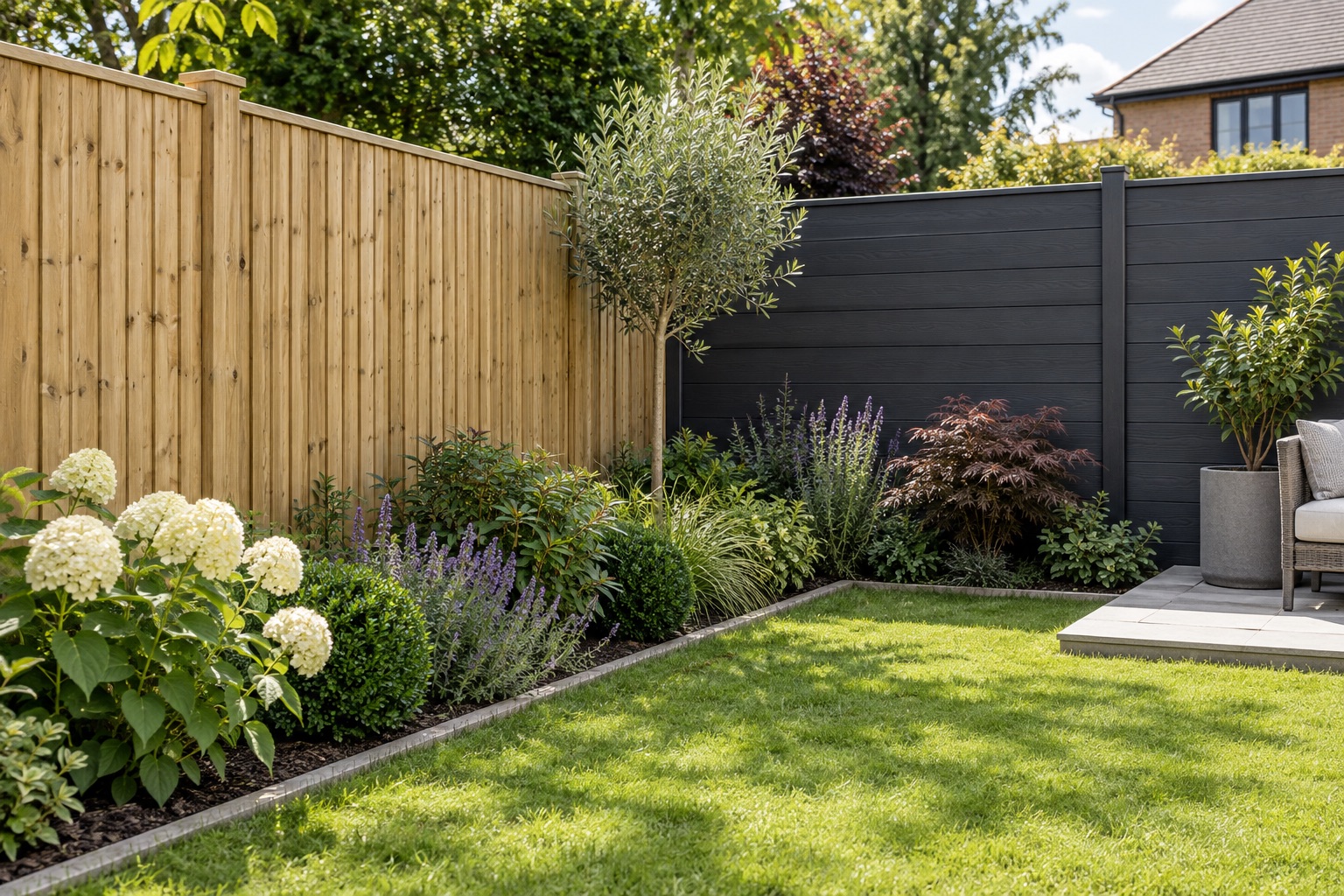
Timber can offer flexible construction and familiar repair options. Composite can reduce some decorative upkeep, but still needs cleaning, suitable supports and product-specific installation. The right choice depends on the garden, appearance, budget and maintenance you actually want.
What are you comparing?
Timber fencing includes overlap panels, framed closeboard, site-built feather-edge, picket and slatted designs. Those options do not all have the same construction, treatment, price or repair method.
Composite is also a broad category. Ask the supplier for the actual board composition, profile, finish and system. Products may use a combination of wood-derived material and plastic, but a general description does not identify the supplied product or the evidence behind its claims.
A composite board can form part of an assembly with metal rails or other supports. A timber fence may use concrete or steel posts. Compare those complete assemblies rather than attributing everything about the finished fence to the visible boards.
A practical comparison
| Question | Timber proposal | Composite proposal |
|---|---|---|
| Appearance | Natural grain, knots and variation; finish depends on timber and coating | Product-specific texture, colour and profile; inspect a physical sample |
| Routine care | Inspection and cleaning; coating upkeep where a finish is chosen or required | Inspection and cleaning to the actual instructions; low maintenance is not no maintenance |
| Installation | Suitable supports, connections, treatment and cutting details | Specified components, spacing, movement allowances and support details |
| Later repair | Identify whether individual boards or complete panels can be replaced | Check access to boards, profiles, accessories and matching replacements |
| Cost | Obtain the full installed specification | Include the complete proprietary assembly and installation requirements |
| Guarantees | Read product and workmanship terms separately | Check covered defects, exclusions, evidence and installation conditions |
This is a buying checklist, not a ranking of every product. A carefully specified option in either material is a different purchase from an incomplete quote with uncertain supports.
Which appearance will you enjoy over time?
For timber, look at the species or supplied timber description, board finish and intended coating. New timber alongside an older run will not necessarily match. Natural weathering, knots and movement should be understood separately from faults affecting the fence's function.
Composite samples help reveal texture and colour better than a small online picture. Ask about the expected weathering of that exact range and whether there can be variation between boards or batches. A printed woodgrain is an appearance choice, not evidence that the product behaves like solid timber.
Consider both sides, posts, capping and junctions. A board sample does not show the whole installed elevation. If the fence meets an older timber gate or neighbouring run, decide how the transition should look.
Our timber appearance guide explains useful distinctions for natural material. Do not judge either option only by its best newly installed promotional photograph.
How much maintenance is involved?
Be specific about the task you want to avoid. Repainting a chosen colour, cleaning green growth, checking supports and replacing a damaged component are different activities. Removing one does not remove all the others.
Timber does not automatically need repainting on a fixed annual schedule. Its treatment, exposure, condition and chosen finish matter. If you want a consistently painted appearance, understand the preparation, compatible products and future access needed for that finish.
For composite, request the manufacturer's care instructions before choosing a cleaner or pressure-washing method. Do not transfer a decking-cleaning recipe to a fence from another range. Dirt and planting still need managing, and hardware and supports remain part of the inspection.
EnviroBuild's fencing document library provides installation, maintenance and warranty documents for its products. That is the kind of product-specific information to request, rather than relying on a general low-maintenance claim.
Installation and movement allowances
Composite fencing must be installed as the selected system requires. Board movement, support spacing, rails, end details and fixing methods can affect performance. Do not assume a board can be tightly trapped between existing posts because its nominal width appears suitable.
Cladco's Signature fencing instructions illustrate product-specific expansion and support requirements. They are not a universal gap or foundation recipe for all composite fences.
Ecoscape's installation overview likewise describes its own components and movement allowances. Ask the installer to identify which current instructions apply to the proposed range and layout.
Timber also needs suitable detailing, treatment of cuts where specified and room for its natural behaviour. Neither material removes the need to assess ground, exposure, access and underground services before foundations are installed.
Can you keep existing concrete posts?
Possibly, but confirm condition, slot dimensions, spacing, level changes and the required supporting parts. A claim that a product fits concrete posts is not proof that it suits every old fence line.
Ask what will carry the boards, how the bottom and top are finished, and how movement and shortened bays are handled. Retaining unsuitable supports can undermine the saving. Our reuse guide helps separate compatibility from concealed condition.
If the retained posts are part of the visual appeal, include photographs of the proposed complete combination. A contemporary board with weathered concrete supports may look different from the supplier's photograph of a fully new matching system.
What happens if one section is damaged?
For both options, ask whether one board, a complete panel or a larger assembly must be removed. Check how access is obtained where planting, sheds or a gate sit beside the affected bay.
With composite, keep the range name, colour, profile and accessory references. A future board from another manufacturer may not fit or perform as required. Ask about replacement availability without treating today's stock as a permanent promise.
Timber replacements also need compatible dimensions and suitable specification. A new board may look different from weathered neighbours even when it is functionally appropriate. Clarify whether appearance matching or retaining sound parts matters more to you.
Which is cheaper?
Get quotations for the same outcome: length, finished height, privacy, posts, gate treatment, removal, foundations and making good. A timber panel price and a composite board price do not describe comparable jobs.
If a supplier argues that future upkeep offsets a higher initial price, ask what maintenance schedule, labour cost, time period and replacement assumptions are included. You may be happy to do some care yourself, or prefer to pay someone. Put those choices into the comparison rather than assuming a universal payback date.
Our fence estimator models provisional timber options only. It cannot price composite by selecting slatted fencing or adding an arbitrary percentage. Obtain a separate complete composite quotation and compare it using the quote checklist.
Lifespan, guarantees and environmental claims
A guarantee period is not a prediction of how every installed fence will look or perform throughout that time. Read the named product's covered defects, exclusions, maintenance obligations and claims process, alongside the contractor's separate workmanship terms.
For environmental claims, ask what the actual supplied components contain, what sourcing evidence applies and what disposal route is available. Recycled content does not by itself establish that a local collection service can recycle the finished board.
Consider retaining suitable components and the ability to repair the assembly. We do not have a lifecycle assessment that ranks every timber and composite system. Our sustainability guide explains how to ask for evidence without turning a material name into an unsupported green claim.
Choosing for a Bedford-area garden
Changing the material does not remove ownership, height, heritage or tree checks. Describe the actual proposed run and finished height, including the base and capping. Use the local project checklist and relevant permission guidance.
For an exposed site or slope, compare the complete proposed system rather than treating either material as automatically windproof or easy to adapt. Ask how the gate and changes of level will be resolved before agreeing the price.
Timber may suit a household wanting flexible detailing, a natural appearance or straightforward component repairs. A suitable composite system may appeal where avoiding a painted finish and choosing a consistent manufactured appearance are priorities. Neither description replaces checking the actual product.
For your enquiry, include approximate dimensions, photographs, preferred appearance and the maintenance you want to avoid. Request both specifications if you are undecided. A useful comparison leaves you knowing what would be installed, how it would be cared for and what later repair would involve.
Compare the main fence styles side by side before narrowing your project brief.