Can you paint or attach things to your neighbour’s fence?
Check permission before painting, drilling, hanging planters or adding trellis, and consider independent screens and suitable supports.
The face towards your garden is not automatically yours to alter. Consent, suitability of the fence and any height or property restrictions need separate consideration.
Why the side you see does not settle ownership
It is easy to think of the surface facing your patio as “your side”. That describes the view, not the legal rights. Before buying paint or fixing trellis, establish whose structure it is and whether there are shared responsibilities. If ownership is uncertain, begin with our boundary ownership guide.
The practical starting point is simple: describe the change and obtain agreement from the person entitled to authorise it. Citizens Advice says you cannot alter a neighbour's fence, including painting your side, without permission. Avoid relying on “they probably will not mind”, especially for a change that is difficult to reverse.
Agree the coating and the method
A paint colour is only part of the proposal. Discuss which surfaces will be coated, whether posts and base boards are included, how edges will be handled and how neighbouring plants and paving will be protected. Thin gaps and board edges can let coating appear on the other face.
Show the actual product information rather than a colour on a phone screen alone. Ask whether the coating suits the material and any previous finish. Follow the manufacturer's current preparation, application and drying instructions; there is no universal waiting time or weather window for every fence product.
A sprayed application can make controlling overspray difficult near someone else's garden. Agree a method that can be controlled and provide protection appropriate to the surroundings. Permission to change the colour is not permission to coat the neighbour's patio furniture or planting.
Hooks, lights, planters and decorative screens
A hook may seem minor, but drilling changes the structure. A planter adds weight, including wet compost and water. A screen can add wind loading. Ask both whether the owner agrees and whether the complete fence can support the proposed addition.
Check the panel, supports and fixings rather than treating a sturdy-looking post as proof. An installer or product supplier may need to assess the proposal. Do not assume a fence panel is a convenient mounting surface for heavy objects, a washing line or equipment designed to be supported independently.
Explain how maintenance will work. If a panel needs replacing later, can the addition be removed without damaging it? Who will disconnect lights or move the planter? A small agreement made now can prevent a simple repair becoming a dispute over attached possessions.
Trellis and climbing plants
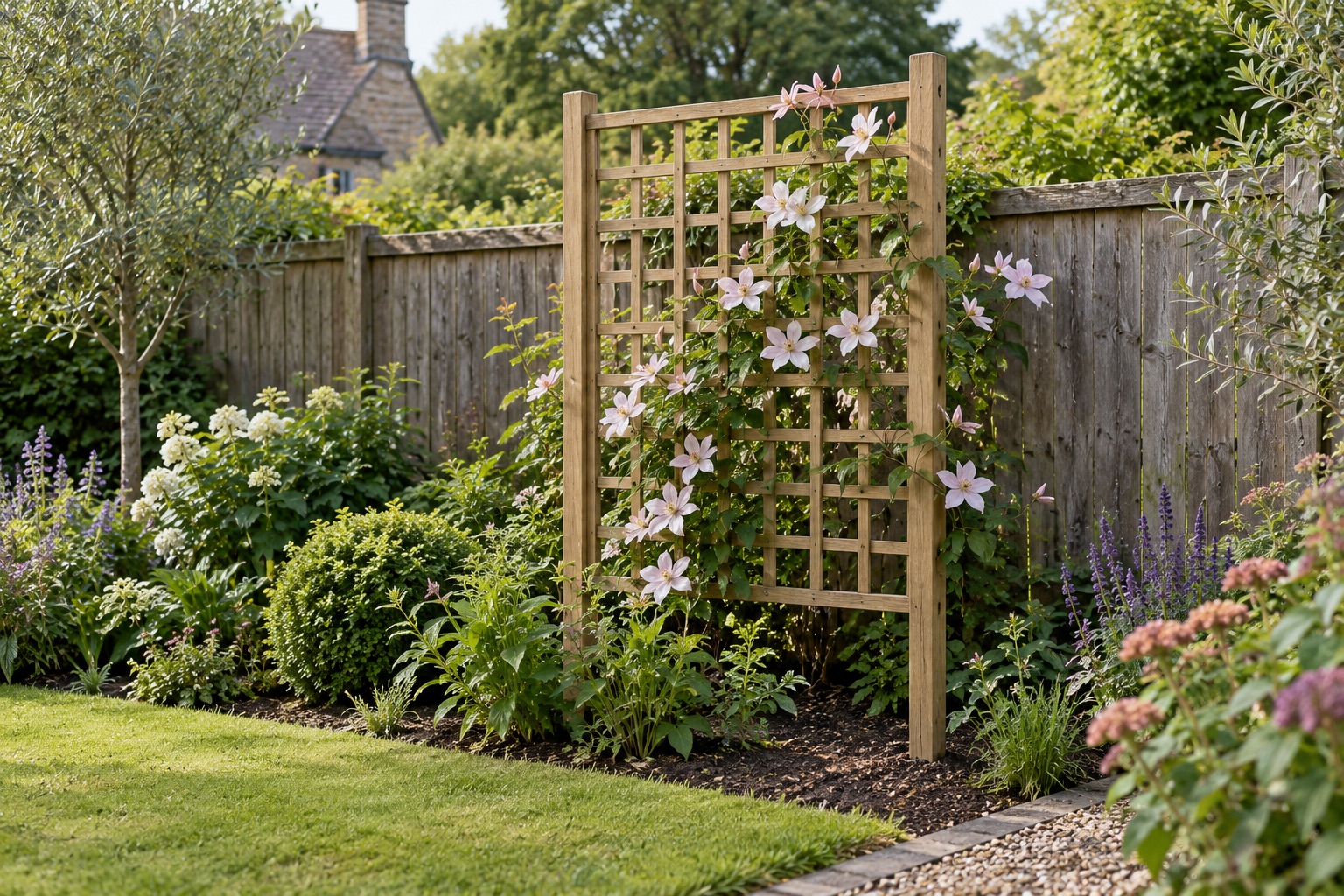
Trellis attached to a neighbour's fence still needs permission, even if it is entirely on the face towards you. Consider the mature plant as well as the empty lattice. Foliage, woody growth and wet vegetation can change the load and make the fence harder to inspect.
Our trellis guide covers supports, planting and the total finished height. If the aim is to add height, the planning question does not disappear because the addition is open or decorative. Present the whole arrangement when making the Bedford planning checks.
Ask who will prune the plant, prevent it spreading where it is not wanted and remove it if the support needs repair. Permission for a lightweight annual climber should not be treated as approval for any future plant of any size.
Could an independent screen solve the problem?
A freestanding trellis or planting scheme on your own land may give you more control over the appearance. It needs its own suitable supports and a position that does not rely on the neighbouring fence. Do not describe something as freestanding if it is quietly wired to the old posts.
Allow for inspection, maintenance and the space required for the plant at maturity. Check the boundary location before setting new posts, and plan excavation around services and roots. A second screen is still a construction and design decision, not a way to avoid all permissions.
Keep the practical purpose in view. If you only want a softer backdrop to a small seating area, a limited screen may be enough. Covering a whole boundary can be more expensive and harder to maintain than the original problem warrants.
What should the permission cover?
- The specific section and surfaces involved.
- The coating or fixture, with a clear product reference.
- How it will be applied or supported.
- Protection, access and timing.
- Responsibility for maintenance, removal and any damage.
- What happens when the existing fence needs replacement.
For an ordinary practical arrangement, a clear written record helps avoid different recollections. If the proposal involves disputed ownership or is intended to create continuing legal rights, obtain appropriate advice on the wording. The checklist is not a legal licence template.
If permission is refused or something has already been added
Ask which part of the proposal causes concern. The issue may be the colour, load, fixings or future maintenance. An independently supported alternative or a smaller change may be acceptable. Do not proceed simply because the work will be hard to see from the other garden.
If something has already been attached to your fence, document it from a lawful position and discuss a proportionate remedy. Avoid pulling off fixtures, cutting wires or painting over another person's work in anger. Where damage or rights are disputed, seek advice. We do not treat every disagreement as an automatic criminal offence; the facts and law need assessment.
Use our dispute preparation guide if discussion stalls. Tenants and leaseholders should also check who can authorise alterations. Agreement with the next-door occupier may not be the only consent required.
Once permission is clear, use our painting and staining guide or plant support guide to define the method.