Fencing on a budget: repair, replace or upgrade?
Prioritise essential fencing work, compare repair and replacement scopes, and plan sensible stages without hiding necessary costs.
In this guideShow sectionsHide sections
Compare a targeted repair, replacement of the affected run and a complete upgrade against the same practical needs. Keeping useful components can save money, but only where their condition, fit and remaining usefulness justify it.
For a materials-and-labour decision, compare the complete DIY and professional installation scope before treating the panel price as the saving.
What does the fence actually need to do?
A limited budget makes it tempting to start with the cheapest panel. Start with the problem instead. Is one bay damaged, is the whole run leaning, or is an otherwise serviceable boundary simply less private than you would like? Those are three different briefs. Pricing them as one full replacement can make a manageable job seem unaffordable.
Write down the essentials in ordinary language: keep the dog within the garden, close a gap beside the gate, restore privacy beside the patio, or replace failing supports. Then separate the improvements you would enjoy: matching every panel, a darker finish, a more decorative top or a different post material. You may still choose them, but you will know what they add.
This is a budgeting framework, not a survey of your fence. An unstable section needs competent assessment before a decision to retain it. Do not push or climb a leaning fence to test it, and keep people away from a section that may fall.
Ask for three useful options
Where the condition permits, ask an installer to explain a minimum sensible repair, replacement of the affected run and a wider upgrade. A repair should address the cause of the fault, rather than hide it. A new panel fitted between failing posts is not a meaningful saving if the supports still need replacement.
| Option | What to establish | Budget trap |
|---|---|---|
| Targeted repair | Which components are sound and what caused the failure? | Paying for a cosmetic fix while the support problem remains |
| Replace one run | Where should new work meet retained fencing? | Forgetting end connections, removal or awkward access |
| Whole-boundary upgrade | Which extra benefits justify replacing serviceable sections? | Treating a preferred appearance as an essential repair |
Our condition-led repair or replacement guide covers the assessment in more detail. Here the question is what each option buys, and whether that matches your priorities.
Put the structure ahead of the finishing touches
Posts, foundations, rails, connections and compatible panels belong in the core specification. Ask what will support the proposed fence, how existing supports will be assessed and what happens if hidden damage is found. The most expensive-looking panel cannot compensate for an unsuitable support arrangement.
Do not select a foundation depth from a general budgeting article. The ground, fence system, exposure and site constraints need consideration. Where excavation is involved, buried services also need planning: HSE's underground-services guidance is a useful starting point for understanding why digging requires more than choosing a spade.
For timber, ask for the intended-use specification rather than relying on colour or the word “treated”. Our timber treatment guide explains the questions to put to the supplier. These details are harder to change after installation than a surface finish or planting scheme.
When keeping parts of the old fence makes sense
Retained concrete posts may allow a panel-only job, provided their condition, alignment, slots and dimensions suit the proposed panels and base boards. Retained timber sections need their connections and condition checked too. “Looks fine from the patio” is a starting observation, not a confirmation that everything can be reused.
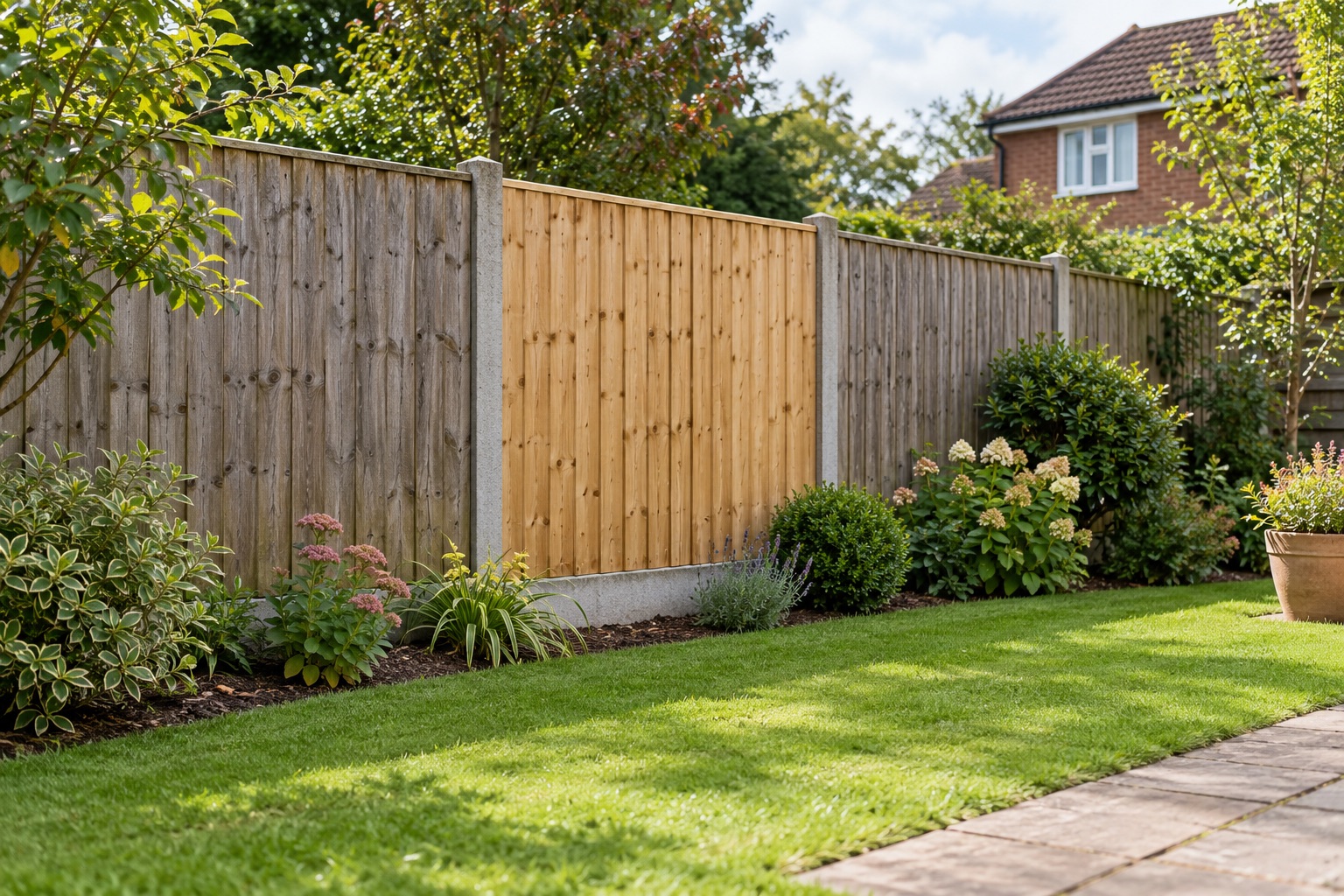
A mixed-age fence may look uneven initially. Decide whether that matters enough to justify extra replacement. One new panel among weathered neighbours can be a sensible outcome for a repair budget. Avoid a promise that a coating will make different materials identical; appearance depends on the products and the existing surfaces.
Ask the quote to name every retained part and explain the assumption behind retaining it. If the installer cannot check a hidden connection until dismantling begins, agree how any necessary change will be explained and priced before extra work proceeds.
Could you complete the work in stages?
Phasing can help where separate runs have different needs. You might replace the failing rear run now and leave a serviceable side boundary for later. Ask whether the first phase will have proper end supports, a complete finish and a safe connection to retained sections. It should stand as a finished job, not rely on an unfunded second phase.
There can be a cost to returning. A second visit may repeat delivery, setup, protection and waste handling. Ask for the combined price and the separate-stage prices rather than assuming two small jobs equal one larger job. Also consider whether doing later work would disturb the first phase or require access that will no longer be available.
Reduce scope clearly, not by leaving gaps in the quote
Possible savings include a simpler finish, fewer decorative details or a smaller clearly defined area of replacement. A different fence style may change the budget, but compare its suitability as well as the price. Reducing height should be a considered design decision around privacy, containment and permissions, not an automatic cost-saving instruction.
Removal is another place where a price can appear smaller. Establish who takes down the fence, who handles the foundations and who removes the waste. If you offer to do part yourself, confirm the handover condition and disposal route. See our removal and Bedford waste guidance before assuming a contractor's waste can use the household route.
Keep the comparison on one sheet
For each option, record the total payable including any VAT, the sections covered, new and retained components, removal, access assumptions and exclusions. Then add what remains to be done afterwards. That last column exposes a cheap first stage that leaves substantial unavoidable work behind.
The indicative estimator can help explore how type, height, posts and removal change a complete new-fence budget. It does not calculate a bespoke repair or prove what Bedford installers charge. Use written site-specific quotations to make the purchase decision.
A useful Bedford-area enquiry
Send the postcode, photographs from safe positions, approximate run lengths and a short list of priorities. Mention narrow access, nearby planting, a shared passage or a gate that needs to remain usable. Those property details tell an installer more than a broad request for the cheapest fence in Bedford.
Explain your budget ceiling if you have one, and ask what a complete sensible scope can achieve within it. Confirm authority to alter the boundary separately. If the affordable option cannot deal with the underlying fault, ask what can safely wait and what needs attention now. A clear reason to postpone an optional upgrade is more useful than a vague assurance that everything can be made cheaper.