Rotten fence posts: repair spur or replacement?
Understand when a purpose-designed post repair may be suitable, what sound structure it relies on and when replacement deserves a separate scope.
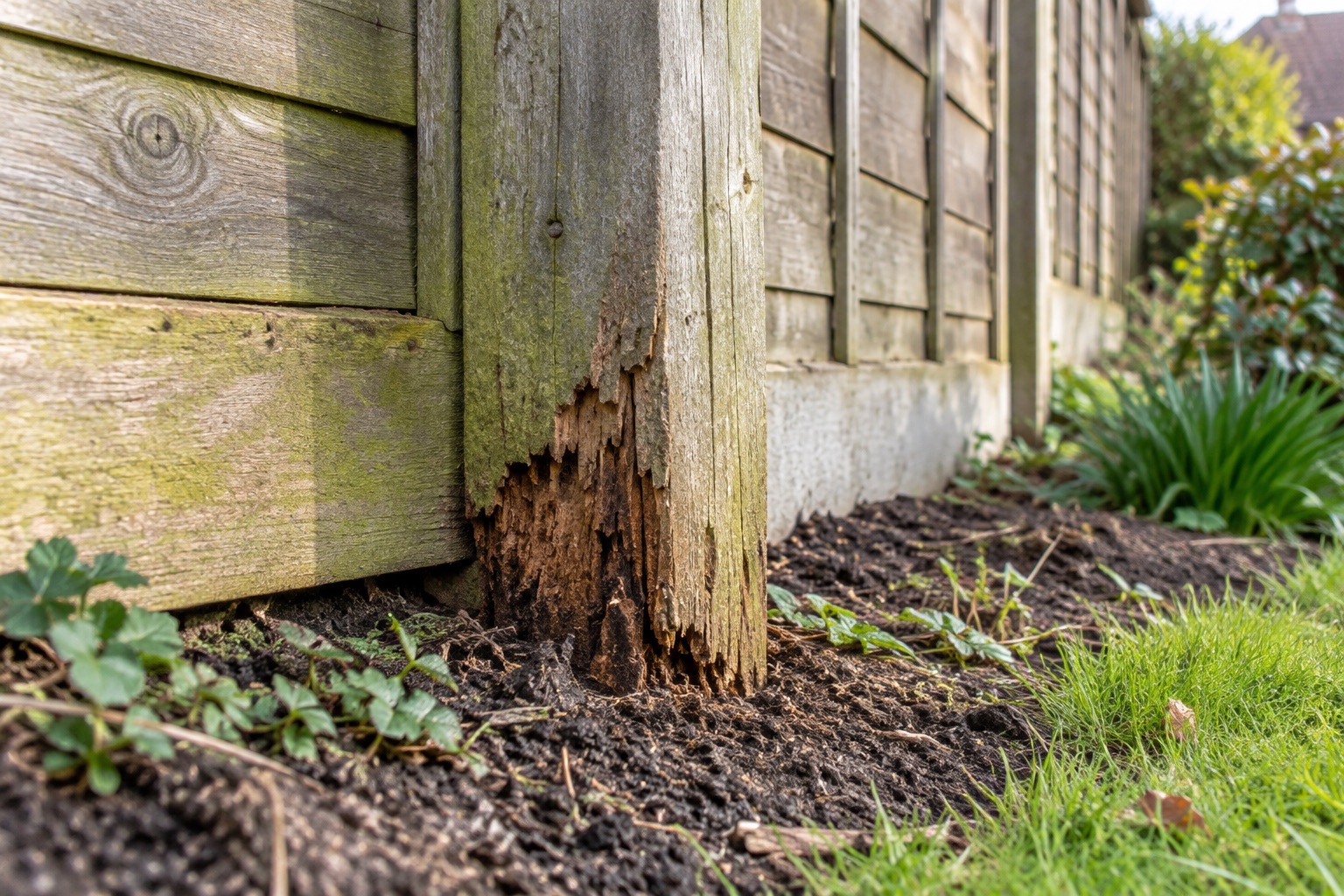
Ask whether there is enough sound timber and a suitable foundation arrangement for the proposed repair. A spur cannot turn extensively decayed wood into a sound structural component.
Why the ground line deserves attention
A post can deteriorate near ground level while much of its visible height still looks acceptable. The condition of coatings or the upper surface does not establish what remains where support and connections matter.
The Wood Protection Association discusses ground-line vulnerability in its pressure-treated post guidance. Use that to understand why specification and installation matter, rather than diagnosing an individual post from colour alone.
If the fence is unstable, keep people away and arrange assessment. Do not deliberately push the post until it breaks, or dig around it to prove the diagnosis while it is still supporting the fence.
What is a repair spur?
A spur is a purpose-designed support installed alongside an existing post as part of a repair arrangement. Products differ in material, dimensions, connections and intended application. The retained timber and supporting ground still matter.
For example, Birkdale's Fencemate technical sheet describes a particular steel repair spur for specified post sizes and ground-level faults. It is a product example, not approval to fit any spur to any rotten post.
Ask what product is proposed, how it transfers support to sound material and what part of the old assembly remains. The instructions for the actual product should govern its use.
What does a concrete repair spur actually support?
A concrete spur gives a retained timber post an additional support arrangement. It does not remove the need for sound material where connections transfer the load, and it does not repair every nearby rail, board or foundation.
Allen Concrete’s spur range illustrates purpose-made precast products for supporting timber posts affected near ground level. Sizes and details vary; ask for the actual product and an assessed installation method. A generic drawing or photograph is not enough to choose the excavation and fixing details.
| Option | What must be established |
|---|---|
| Concrete spur | Useful retained timber, compatible connections, room for the support and suitable groundwork. |
| Purpose-designed steel repair spur | The specific product’s application, post fit, fixings, finish and foundation requirements. |
| Replacement post | Old foundation handling, new support, reconnection and the condition of adjacent components. |
Spurs made from different materials are not interchangeable details. Birkdale’s Fencemate steel-spur sheet is a separate product reference. It should not be used as the fixing specification for a concrete support.
If the installer cannot rely on the retained timber or resolve the groundwork properly, ask for a replacement option. Do not choose a repair solely because the visible new part is cheaper. Compare the finished support arrangement, its limits and the total work.
When might a supported repair be worth considering?
A competent assessment may find a local fault with useful structure above it and compatible adjacent components. In that case a defined repair could avoid unnecessary dismantling. The proposal should explain the condition it relies on, the new support and how affected panels or rails are reconnected.
It should also identify limitations. A repaired post may remain visually different, and it does not renew every old fixing, rail or neighbouring support. Ask which components are excluded from the work.
Our retention guide helps organise those questions. Reuse is a reasoned choice when parts remain suitable, not an instruction to keep as much old material as possible at any cost.
When replacement needs serious consideration
Replacement may be more appropriate where decay is extensive, connections cannot rely on sound timber, several faults interact or the new design asks more of the support. An installer should explain the assessment rather than recommend a spur solely because it is quick to quote.
Ask for a replacement scope that includes removal or treatment of the existing foundation, new compatible support, reconnection and disposal. A price for a bare post does not describe that job.
If several posts are affected, compare a defined section replacement with multiple local repairs. Our wider repair decision guide keeps that comparison focused on what each option achieves.
Can preservative, filler or paint solve the problem?
A surface coating should not be presented as restoring the load-bearing capacity of decayed timber. Cosmetic filling or painting may conceal the area without resolving the support fault. Ask what evidence supports any proposed structural repair method.
For new timber, specify the intended use and appropriate treatment. WPA's Use Class 4 campaign addresses ground contact and exterior structural support. A colour or generic “treated” label is not a complete specification.
Its post-installation guidance also covers protecting treated timber and drainage. Follow the actual product guidance, including cut-end restrictions; brushing on preservative is not a substitute for suitable industrial treatment.
The foundation still needs a plan
A repair support or replacement post may require excavation beside old concrete. Ask what happens if the existing block obstructs the intended position. Do not accept an unassessed shallow fixing simply because removal would take longer.
Read foundation questions and buried-service checks before treating this as a minor hole with no wider constraints. Nearby roots, drains and the legal boundary can also affect the method.
Compare complete repair and replacement prices
Ask each quotation to identify the new components, retained parts, foundations, fittings, access, disposal and total payable. Include any disturbance to adjacent bays and making-good. Clarify how a defect discovered during dismantling would be authorised.
Our post cost guide gives context without inventing Bedford repair rates. The new-fence estimator is not a tool for pricing one post or one repair spur.
After the work
Keep photographs and a record of the new support, retained components and written terms. Ask the installer to explain any maintenance or restrictions. A local repair can be sensible when the basis for retaining the remaining fence is clear.
If movement returns, report it with dates and safe photographs rather than repeatedly tightening or adding improvised supports. The next assessment should consider the complete arrangement and the earlier repair, not just repeat it automatically.